

Cleaning pale or dark spotting from a leather chair after a leak may seem straightforward. But the wrong liquid, too much friction, or forced drying can leave a larger water ring, lift color, change the finish, or push more moisture into seams.
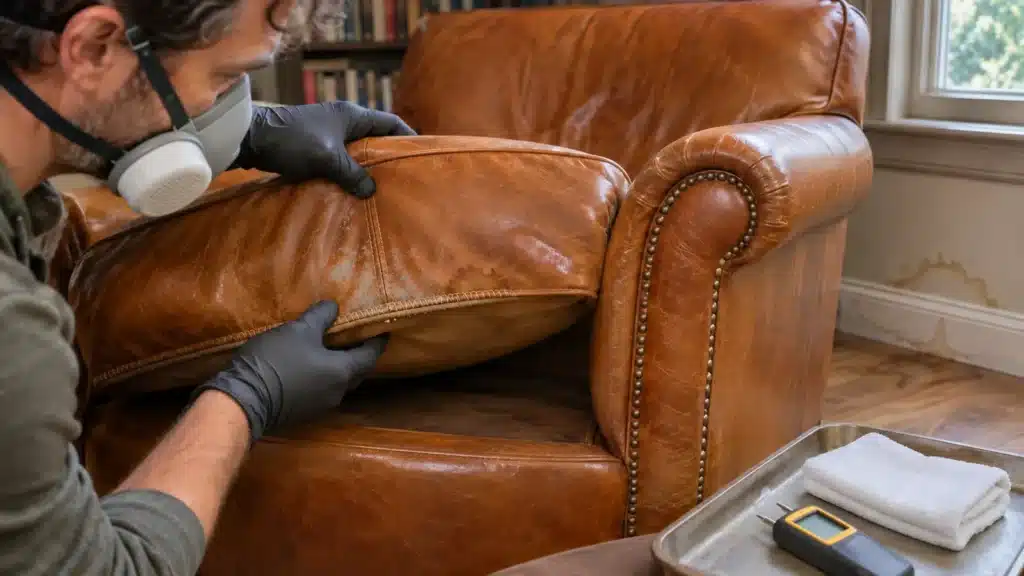
The question “how do I remove mildew from leather?” therefore has no safe one-mixture answer. First determine what kind of leather you have, where the water traveled, whether the item is fully dry, and whether the water was reasonably clean.
Treat “Mildew” as Suspected Fungal Growth
Mildew is commonly used to describe certain flatter forms of mold. Our guide to mold and mildew on leather and stored fabrics explains that appearance is only a clue.
White, gray, green, or dark spotting does not identify a fungal species or establish how hazardous it may be. The CDC notes that mold occurs in many colors, and color does not indicate whether one type is more or less dangerous.
A musty odor also cannot tell you whether growth is limited to the leather surface. After a leak, moisture may have reached:
- Stitching and unfinished leather edges
- The fabric deck beneath removable cushions
- Cushion foam or batting
- Wood or composite framing
- Flooring, baseboards, or walls behind the furniture
Cleaning the visible leather cannot correct wet material underneath it.
Does Water Damage Leather?
Yes. Water can darken, stiffen, distort, stain, or weaken leather. The result depends on the tanning process, surface finish, exposure time, contaminants, and drying conditions.
The Leather Working Group’s definitions distinguish aniline, semi-aniline, pigmented, and coated leathers by their surface treatments. Those differences matter because open-pore aniline leather, nubuck, and suede generally absorb liquids more readily than heavily protected leather.
Conservation guidance from the National Park Service also documents the underlying material risk: direct wetting can cause aged leather to stiffen, darken, shrink, or deform. That museum guidance should not be treated as a household cleaning recipe, but it illustrates why adding more moisture is not automatically harmless.
| Condition after the leak | Is limited home care reasonable? | Main concern |
|---|---|---|
| Small, dry surface patch on known protected leather after a clean-water leak | Possibly, if the manufacturer permits the proposed method | Finish and color still require testing |
| Unknown leather or unknown finish | Stop before wet cleaning | The wrong product may alter color, gloss, or texture |
| Aniline, nubuck, suede, unfinished, antique, or fragile leather | Specialist assessment is safer | High sensitivity to water and cleaning agents |
| Damp cushions, lining, seams, or frame | Surface cleaning is insufficient | Hidden moisture and fungal growth may remain |
| Sewage, outdoor floodwater, or an unknown water source | Do not treat it as routine furniture cleaning | Contamination changes the handling and salvage decision |
| Widespread growth, recurring odor, or multiple affected materials | Investigate the larger moisture problem | The furniture may be only one affected surface |
A Safer Decision Path for Leak-Affected Leather
The first goal is to stop additional damage. Cosmetic stain removal comes later.
1. Document and Control the Leak
- Photograph the furniture and nearby damage before cleaning if an insurance claim may be involved.
- Stop the leak or move the item away from continuing moisture when it is safe to do so.
- Do not move heavy furniture across wet flooring without help, and do not enter an area with electrical, structural, sewage, or unknown floodwater hazards.
2. Identify the Water and the Leather
Determine whether the water came from a supply line, roof, appliance, drain, sewage backup, or outdoor flooding. Water that began in a potable line should not automatically be treated as clean after it has passed through building materials or remained in absorbent furniture.
Then check the furniture label, purchase documents, or manufacturer’s care instructions. Do not rely on appearance alone to distinguish protected leather from aniline leather or a synthetic imitation.
3. Let the Material Stabilize Before Cleaning
Blot removable surface moisture with a clean, absorbent white cloth. Do not rub, twist, or press water farther into seams.
Allow the item to dry at room temperature with controlled air circulation. Keep it away from hair dryers, heaters, steam equipment, and harsh sunlight. These can dry the surface unevenly or alter the leather before deeper layers are dry.
Collection-conservation guidance from the Canadian Conservation Institute says that fungal growth which smears during controlled removal may indicate that the leather is not dry enough to clean. Its HEPA-vacuum procedure is intended for trained conservation work, not as permission to brush or vacuum mold through an occupied room with ordinary equipment.
4. Attempt Only Compatible Surface Care
Limited home cleaning may be reasonable only when all of the following are true:
- The affected patch is small and limited to the surface.
- The leather and finish are known.
- The water was not sewage, floodwater, or otherwise contaminated.
- The cushion, lining, and frame are dry and unaffected.
- The manufacturer permits a specific cleaning product or method.
- Nobody performing the work has a condition that makes mold exposure unsafe.
- Use gloves and avoid touching suspected growth with bare hands.
- EPA guidance recommends an N95 respirator, gloves, and eye protection when disturbing even a small mold-affected area.
Its general “less than about 10 square feet” benchmark is not an automatic DIY approval for furniture because material value, hidden moisture, contamination, and personal health still matter. See the EPA’s mold-cleanup guidance.
For a manufacturer-approved method:
- Test the product in a concealed area.
- Allow the test area to dry completely before judging it.
- Put the smallest permitted amount on a white cloth rather than pouring or spraying it onto the leather.
- Blot or wipe gently as directed without saturating seams.
- Let the area air-dry naturally.
- Stop if color transfers to the cloth or the surface becomes lighter, darker, sticky, stiff, rough, cloudy, or unusually glossy.
Manufacturer instructions control. For example, American Leather’s care guidance advises prompt blotting, minimal distilled water for minor spills, natural air-drying, and avoiding saddle soap, solvents, furniture polish, oils, abrasives, detergent soap, and ammonia.
Why Cleaning Can Worsen Staining or Odor
A treatment may remove loose surface residue while creating a separate leather problem.
Water Rings and Dye Movement
Spot-wetting can create a sharp boundary between treated and untreated leather. On absorbent leather, moisture may move dyes, oils, or soluble material outward as it dries, leaving a halo larger than the original mark.
Repeatedly wetting only the darkest point may make that contrast more noticeable. Follow the manufacturer’s instructions if they call for treating an entire panel from seam to seam.
Finish Damage From Household Products
Internet recipes commonly recommend vinegar, rubbing alcohol, bleach, dish detergent, saddle soap, or combinations of those products. The problem is that advice developed for one leather or conservation setting may damage another finish.
Never mix cleaning products. Do not escalate to a stronger chemical because the first treatment failed. A persistent mark may be permanent fungal staining, water damage, dye loss, or finish damage rather than removable surface residue.
Hidden Moisture and Recurring Odor
A cleaner or fragrance may temporarily cover a musty smell without reaching wet foam, batting, fabric, or wood. Odor that returns as the item warms up or indoor humidity rises is a reason to inspect deeper layers and the surrounding room.
Do not apply conditioner, protectant, oil, or deodorizer until the item is fully dry and the manufacturer confirms the product is compatible. Adding products too early can complicate stain evaluation and future treatment.
When to Stop Cleaning and Request an Assessment
Stop home treatment when:
- The leather type or finish cannot be confirmed.
- Growth reaches seams, perforations, backing, cushions, or the frame.
- The item remained wet long enough for internal materials to stay damp.
- The water involved sewage, outdoor flooding, or unknown contaminants.
- The leather has warped, hardened, cracked, become sticky, or lost color.
- The musty odor remains after the surface and room appear dry.
- Spotting returns after cleaning.
- Several furnishings or building materials are affected.
- The item is valuable, antique, sentimental, or difficult to replace.
- Anyone in the home has asthma, severe allergies, immune suppression, or another relevant health concern.
The EPA cautions that porous mold-affected materials can be difficult or impossible to clean completely. For floodwater or disaster exposure, the CDC advises discarding items that cannot be cleaned and dried quickly, including upholstered furniture in contaminated conditions.
If the leak also affected floors, walls, or other building materials, our water damage restoration services page provides the relevant service path. Our upholstery cleaning page identifies leather among the materials we clean, but the specific leather, contamination history, and internal furniture condition should be confirmed before treatment.
The practical rule is simple: limited cleaning is for a small, dry, surface-only problem on identified leather using a method approved for that finish. When the material, water source, or depth of moisture is uncertain, another cleaning attempt can make the eventual restoration harder.
Frequently Asked Questions
Can mildew stains remain after the fungal growth is removed?
Yes. Residual discoloration may be fungal staining, a water mark, migrated dye, or damage to the surface finish. A remaining mark does not automatically prove that active growth remains, but repeated wet cleaning may enlarge the stain. Let the leather dry fully and have the mark assessed before escalating treatment.
Does water damage leather permanently?
It can. Short contact with water may leave no lasting change on some protected leathers, while prolonged wetting can darken, stiffen, distort, or weaken more absorbent leather. The finish, water source, exposure time, and drying method all affect salvageability.
Can I use vinegar or rubbing alcohol on moldy leather?
Do not use either as a universal treatment. Some conservation and extension sources describe alcohol-based methods for particular leather objects, while many furniture manufacturers warn against alcohol, solvents, acids, or unapproved cleaners. Follow the instructions for the exact item and finish.
Is bleach safe for removing mildew from leather?
Bleach is not a routine leather cleaner. It can discolor leather or damage its finish, and a product registered for hard, nonporous surfaces is not automatically suitable for leather upholstery. Never mix bleach with vinegar, ammonia, or another cleaner.
Why does the leather still smell musty after I clean it?
The odor source may be in seams, lining, foam, batting, the frame, or nearby building materials. It may also indicate that the item or room is not fully dry. Masking the smell does not establish that the moisture or fungal-growth problem has been corrected.
Can I dry wet leather with a fan, hair dryer, or sunlight?
Avoid hair dryers, heaters, and prolonged direct sunlight because rapid or uneven drying can change leather’s color, texture, and shape. Controlled room-temperature airflow may help after exposure has been assessed, but do not aim a fan across visible growth in an occupied room because disturbing mold can spread particles.
When should a leather sofa be discarded instead of cleaned?
Replacement may be more appropriate when contaminated water has saturated porous interior materials, the cushion or frame cannot be completely dried and cleaned, fungal growth is extensive, the odor persists, or the leather has lost structural integrity.
Value, replacement cost, health considerations, and professional salvageability assessment should all inform the decision.
