

A dishwasher, sink, or water heater leak can leave the same visible clues: raised board edges, dark seams, swelling, or a floor that moves underfoot. Those symptoms do not all call for the same repair. The right fix depends on the flooring type, where the water traveled, contamination, and what the floor and subfloor do after controlled drying.
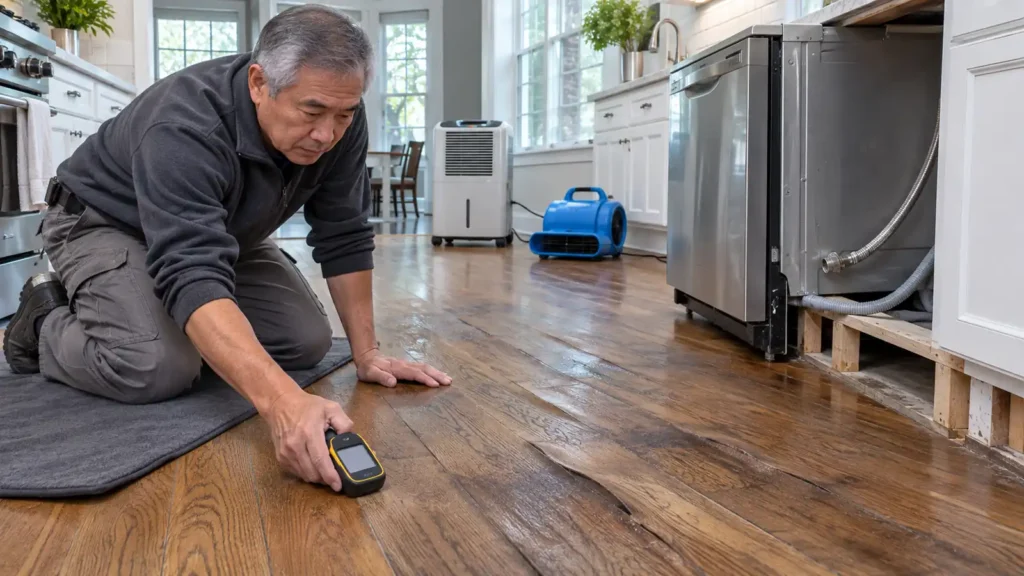
The short answer to how to fix a wood floor damaged by water is: stop the leak, make the area safe, map and dry the entire wet assembly, and postpone cosmetic repairs until moisture readings stabilize. Some solid hardwood recovers enough to keep. Buckled boards, separated engineered planks, or a damaged subfloor may require replacement.
What to Do Before You Repair the Floor
The first hours are for damage control, not sanding or choosing stains. Water can move under cabinets and flooring farther than the surface puddle suggests.
- Stop the water at a safe control point.
- Close the relevant supply valve or the main water valve.
- For a water heater or powered appliance, follow the manufacturer’s shutdown instructions or call a plumber or qualified technician.
- Never touch a wet appliance, operate a switch, or enter standing water to reach a breaker.
- Document the source and damage.
- Photograph the failure, floor, cabinet toe-kicks, baseboards, and any ceiling below.
- Keep receipts and moisture records. If insurance may be involved, ask the insurer what it needs before permanent repairs begin.
- The Arizona Department of Insurance and Financial Institutions notes that coverage depends on the policy and cause of loss, not simply the presence of water.
- Remove surface water only when conditions are limited and safe.
- Towels or a liquid-rated wet/dry vacuum may be reasonable for a small, recent supply-water leak after electrical safety is confirmed.
- Do not use an ordinary vacuum.
- Stop DIY cleanup if water contacts wiring, comes from a sink drain or dishwasher discharge, contains debris or chemicals, has been present for an uncertain period, or spread into concealed materials.
- Open an assessment path.
- Check adjacent cabinets, toe-kick cavities, baseboards, transitions, and the room below.
- Do not pull a hard-wired appliance, cut flooring, or disturb suspect old adhesives or underlayment without the appropriate trade or hazardous-material assessment.
The EPA recommends drying wet materials within 24 to 48 hours when possible to reduce the chance of mold growth. That is a response goal, not proof that a hardwood floor will be dry in two days.
Why the Leak Source Changes the Response
Water that began as potable does not remain automatically clean after it crosses dirty surfaces or sits inside an assembly. Source, contact, time, and evidence of contamination all matter.
Dishwasher Leaks
A pressurized supply-line leak may release relatively clean water, while drain or wash water contains food residue and detergent. Either can travel beneath the machine, cabinets, underlayment, and finished floor before appearing at an exposed edge.
Sink Leaks
A faucet supply leak is different from an overflowing basin, failed garbage disposal, or leaking drain. Empty the sink cabinet and inspect its base and plumbing penetrations, but do not assume the visible cabinet damage marks the full moisture boundary.
Water Heater Leaks
A tank or connection failure can release a large volume, and nearby controls may involve electricity or gas. Keep clear of wet electrical components, hot water, unstable ceilings, and any gas odor. A qualified technician should correct the equipment failure before floor repair begins.
How Professionals Determine Whether the Floor Is Dry
Drying is complete when measurements show that the affected flooring and substrate have returned near their expected in-use condition, not when the surface feels dry.
The National Wood Flooring Association’s 2025 guidelines call for testing the flooring and subfloor at multiple depths, mapping the affected area, and comparing readings with unaffected wood in the same building. Its repair guidance uses a target within 2 percentage points of the expected in-use moisture content.
This is why “How long do hardwood floors take to dry?” has no reliable fixed-day answer. Saturation, floor construction, installation method, subfloor, access, indoor conditions, and the drying setup all affect the timeline. A floor assembly may require days or longer. Appearance and elapsed time alone cannot confirm dryness.
Professional drying may combine dehumidification, controlled airflow, and systems designed to move air above or below the floor. Excessive or poorly controlled heat can damage other wood products. Fans also should not be used casually where visible fungal growth or contaminated water could be spread.
Choose the Repair Only After Drying and Stabilization
The floor’s condition after drying determines the repair. Starting to finish work while the boards or subfloor remain wet can lock in the wrong decision.
Dry and Monitor
Minor cupping can lessen or disappear as the flooring dries. If the boards return flat, the finish remains intact, the subfloor is sound, and readings stabilize, the floor may need no structural repair. Continue watching for renewed movement, odor, staining, or elevated readings.
Recoat, Sand, or Refinish
A dry, stable solid-wood floor with finish damage, shallow staining, or slight residual unevenness may be a refinishing candidate. Never sand the floor while it is still cupped. Sanding off raised edges too early can leave the centers higher after the boards finish drying, a condition called crowning.
Engineered flooring has a finite wear layer, so its manufacturer’s refinishing limits matter. Deep discoloration may remain after sanding.
Replace Individual Boards
Localized replacement may work when only a few boards remain split, deeply stained, detached, or distorted, while the surrounding floor and subfloor are dry and sound. A durable match involves species, grade, width, thickness, edge profile, bevel, grain, finish, sheen, and installation method. A larger continuous area may need refinishing for a consistent appearance.
Replace a Larger Section or the Floor Assembly
The NWFA states that buckled flooring requires replacement where buckling occurred because the fasteners or adhesive are no longer effective. Replacement is also more likely when engineered plies separate, the flooring cannot be cleaned after contamination, or plywood or oriented-strand-board subflooring shows swelling, distortion, loss of strength, or delamination.
| Condition after drying | Likely next step |
|---|---|
| Minor cupping relaxes; finish and subfloor remain sound | Monitor, with recoating only if needed |
| Boards are dry and stable but have repairable finish damage | Evaluate sanding and refinishing |
| A few boards remain split, stained, loose, or distorted | Replace affected boards and blend the finish |
| Boards are buckled or engineered layers have separated | Replace affected flooring |
| Subfloor is soft, swollen, delaminated, or still wet | Expose, assess, and repair the subfloor before new flooring |
| Water was contaminated or fungal growth is visible or suspected | Stop DIY work and obtain qualified assessment |
Visible discoloration, odor, or growth does not identify an organism by appearance alone. “Mold” describes fungi; “mildew” is an informal term often used for certain surface fungal growth. Testing is not automatically required for every visible patch, but the moisture source and affected materials still need evaluation.
The Repair Is Finished Only When the Assembly Is Ready
Knowing how to repair water-damaged wood means separating mitigation from finish work. First verify that the leak is corrected, the moisture boundary has been addressed, and the flooring and subfloor meet an appropriate dry target. Then decide whether the stable result calls for no repair, refinishing, individual board replacement, or broader reconstruction.
If water has spread beneath flooring or cabinets, Semper Fi Floor Care & Restoration’s water damage restoration service includes water extraction, structural drying, and damage assessment. An on-site evaluation can establish the affected area and drying needs before permanent floor repairs begin.
Frequently Asked Questions
Can a Swollen Wood Floor Go Back Down on Its Own?
Minor cupping in solid hardwood may relax during drying, but “swollen wood floor” can also describe buckling, engineered-wood delamination, or a swollen composite core. Buckled sections and separated plies generally require replacement. Do not judge the outcome until the floor and subfloor have been measured and stabilized.
How Do You Fix Water-Damaged Hardwood Floors Without Replacing Them?
When the water source is controlled, the loss is suitable for drying, the subfloor remains sound, and the boards stabilize, the floor may only need monitoring, recoating, or refinishing. Sanding is a later cosmetic step, not a drying method.
How Long Do Hardwood Floors Take to Dry After a Leak?
There is no universal number of days. Drying can take days or longer depending on saturation, floor construction, subfloor, indoor conditions, and access for drying. Completion should be based on properly interpreted moisture readings compared with unaffected materials and expected in-use conditions.
Should I Run Fans on a Wet Wood Floor?
Only after electrical safety and water cleanliness have been assessed. Controlled airflow and dehumidification can support drying, but ordinary fans may be inadequate for moisture trapped below flooring and can spread contamination or fungal material. Avoid improvised high heat.
Can I Sand Down Cupped Boards Right Away?
No. If cupped boards are sanded before their moisture content stabilizes, they can change shape as they continue to dry and leave a crowned surface. Wait for the moisture source to be corrected and the flooring and substrate to reach the proper dry condition before evaluating sanding.
Does a Dishwasher or Sink Leak Mean the Entire Kitchen Floor Must Be Replaced?
Not automatically. The repair scope follows the actual moisture footprint, contamination, installation method, subfloor condition, permanent board damage, and availability of matching material. A localized board repair may be possible, while finish blending may extend beyond the replaced boards.
When Should I Stop DIY Cleanup and Call Professionals?
-Stop when water is near electrical or gas equipment; came from a drain, dishwasher discharge, sewage source, or uncertain source; spread beneath cabinets or flooring; affected a large area; produced buckling or soft spots; remained for an uncertain period; or is accompanied by visible or suspected fungal growth.
-Also get qualified help when you cannot verify that concealed materials are dry.
