


Attic water damage rarely starts with a dramatic puddle. It usually begins quietly, during the same seasonal patterns that stress buildings the most: wind-driven rain that finds weak flashing, humid swings that trigger condensation on ductwork, and seasonal turnovers when a vacant unit sits just long enough for a slow drip to soak insulation.
For homeowners, business owners, and property managers, the attic adds one complication: gravity. Water that starts overhead can spread across framing, insulation, and ceiling cavities, then appear days later as stains, odors, warping, corrosion, or finish failures.
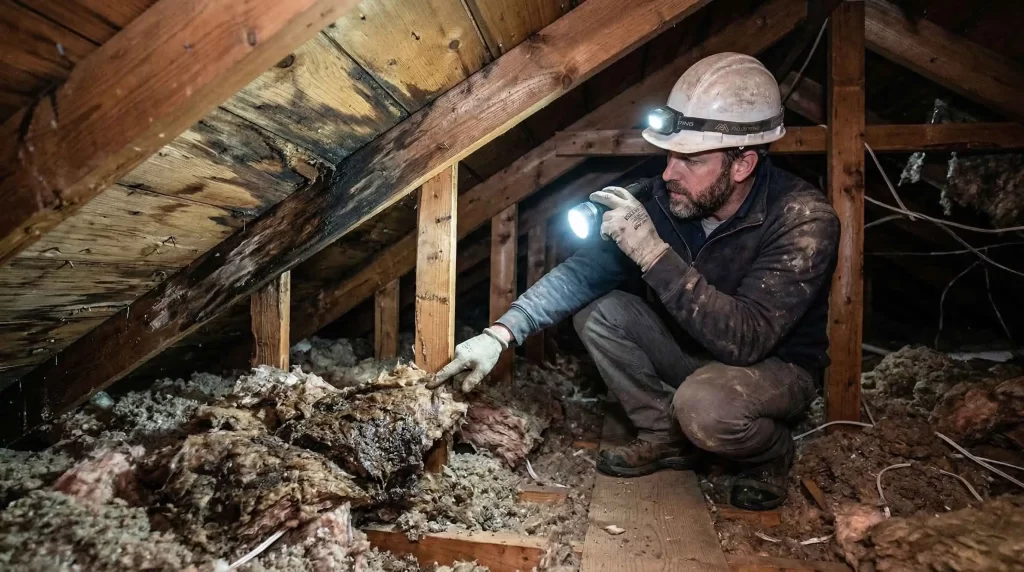
If you want to prevent secondary damage, you need a plan that focuses on detection first, then controlled drying and restoration.
Common causes of attic water damage
Attic water damage usually comes from one of two buckets: exterior intrusion or interior moisture.
Exterior intrusion causes
- Roof leaks: Missing or damaged roofing materials, fasteners, or aged sealants can let water in.
- Flashing failures: Valleys, chimneys, skylights, and roof-to-wall transitions are frequent leak points because they rely on layered flashing details.
- Clogged drainage paths: When gutters or downspouts back up, water can push under the edges and find its way into the sheathing.
Interior moisture causes
- HVAC or duct condensation: Cold ductwork in a warm attic can collect moisture, especially when insulation is missing or vapor barriers fail.
- Bathroom or kitchen exhaust issues: Improperly vented moisture can dump humid air into the attic and condense on cooler surfaces.
- Plumbing leaks: Supply lines, drain connections, or equipment routed through attic spaces can leak slowly and saturate insulation before you notice.
A key takeaway from high-ranking industry blogs on this topic is that homeowners often confuse condensation patterns for roof leaks. Condensation tends to present more broadly across surfaces, while active roof leaks often show localized staining or wetness tied to weather events.
That distinction matters because it changes the fix. (You still want a professional to verify the source, but knowing what to look for can speed up the right decision.)
How to detect attic water damage early
Because attic damage hides above insulation and below roof decking, early detection is about patterns and small signals.
Visual signs from inside the living space
- Yellowing or brown ceiling stains that grow over time
- Bubbling paint, sagging drywall, or soft spots around ceiling fixtures
- Peeling tape lines at ceiling seams or crown molding separation
- New warping in door frames or trim near top plates
Signs inside the attic (if it is safe to access)
- Damp or matted insulation and darker “shadowing” on sheathing
- Rusting fasteners, metal straps, or HVAC hangers
- Water streaks on rafters or roof decking
- Musty odors that intensify when the attic warms up
- Wetness around vent penetrations, duct connections, or plumbing chases
Safety-led access note
Avoid walking on the ceiling drywall from the attic side. Step only on framing members if you have safe access and adequate lighting. If you see active dripping, electrical components near moisture, or extensive saturation, pause and contact qualified professionals.
Why speed matters, even if the leak seems small
Attic water damage creates a high risk of hidden saturation. Insulation holds water. Framing can wick moisture. Ceiling cavities can trap humidity. That is how you end up with secondary problems like odor absorption, re-wetting after “drying,” and hidden mold risk behind finishes.
The U.S. EPA’s mold guidance uses a 24 to 48 hour response window as part of mold-prevention decision-making after water damage, which is why early detection and controlled drying matter. Use that timeframe as a practical urgency signal, not a guarantee.
Restoration steps for attic water damage
A high-quality restoration process follows the water, then verifies it is gone.
Step 1: Stop the source and protect downstream areas
- Address the roof, flashing, or plumbing source first (or arrange for qualified repair).
- Protect ceilings and contents below with containment and controlled water capture if active dripping continues.
- Limit HVAC operation if it appears to be contributing to condensation until the cause is evaluated.
Step 2: Damage assessment and moisture mapping
The attic is a prime place for hidden moisture. A professional assessment should define the true wet footprint, including areas that do not show staining yet. We conduct damage assessment and moisture mapping using tools such as infrared thermal imaging and moisture meters to detect moisture behind walls and ceilings and assess saturation in materials. (That same measurement mindset applies to attic losses, where moisture often hides above ceilings and under insulation.)
Step 3: Water removal and controlled demolition (as needed)
Attics typically do not have “standing water” like a basement, but saturated insulation behaves like a reservoir. Depending on the loss:
- Wet insulation may need removal to allow framing and decking to dry.
- Damaged ceiling drywall may require selective removal to release trapped moisture and prevent re-wetting.
- Non-salvageable porous materials should be documented and disposed of appropriately.
Step 4: Structural drying and humidity control
Drying an attic is not just running fans. It is airflow plus dehumidification targeted to the wet zones. On our site, we reference using advanced equipment to extract standing water, dry affected areas, and prevent long-term damage as part of water damage restoration.
The same principle applies to overhead: you need strategic drying that reaches cavities, not just surfaces.
Step 5: Cleaning, sanitization, and odor control
Attic water damage can leave behind dust, insulation debris, and residues. If the source involved contaminated water (for example, a backup affecting ceiling cavities), cleaning and sanitization become even more important. Even with clean-water leaks, odors can embed into insulation and wood if moisture lingers. The goal is to remove soils first, then apply appropriate treatments based on the situation and materials involved.
Step 6: Mold remediation when growth is present or suspected
Do not assume every attic leak equals mold, and do not ignore the possibility. If moisture persists or the attic has poor ventilation, mold can develop on decking, framing, or insulation. If mold is suspected, consult qualified professionals for evaluation and next steps rather than disturbing materials and spreading debris.
Step 7: Repairs and a final verification walk-through
A smart closeout check:
- Moisture levels in the original wet footprint and adjacent edges
- Re-wetting risk zones (around penetrations, duct runs, and low-airflow corners)
- Ceiling finish integrity below the attic (no new staining or soft spots)
- Odors under normal HVAC operation
- Documentation for property records, management, or insurance
That 24 to 48-hour EPA benchmark is also useful after repairs: if you ever see re-wetting or new staining, treat it as time-sensitive and investigate quickly.
When you need a restoration team, not a guess
Attic water damage is easy to underestimate because it is out of sight. The safest approach is measurement-led drying, careful material decisions, and a closeout that verifies the attic and the ceilings below are stable.
We are Semper Fi, veteran-owned and operated, and hold a Licensed Contractor – ROC# 349271. Call Now – (928) 504-6179 to get your restoration started.
Frequently Asked Questions
1) What is the most common cause of attic water damage?
Roof leaks and flashing failures are frequent culprits because water can enter at transitions and travel along framing before it becomes visible. Condensation on ductwork and poor exhaust venting are also common, especially during heavy HVAC seasons.
2) How can I tell if it is a roof leak or condensation?
Roof leaks often create localized wet spots that worsen during or after weather events. Condensation tends to appear more broadly, such as widespread dampness on sheathing or ductwork, especially during temperature and humidity swings. A professional inspection can confirm the source’s safety.
3) Why do I see a ceiling stain but no attic puddle?
Water can absorb into insulation and spread laterally along framing, then drip slowly through a seam or fastener. By the time you see a stain, the attic insulation above it may be saturated like a sponge. That is why moisture mapping matters.
4) Is attic water damage urgent if the stain looks small?
Yes. Small stains can indicate larger hidden saturation. The EPA references a 24 to 48-hour response window as part of mold-prevention decision-making after water damage, which supports acting quickly to reduce secondary damage risk.
5) What should I do first if I suspect attic water damage?
Stop the source if it is safe, document the damage with photos, and protect the contents below. Avoid electrical hazards and do not step on the ceiling drywall from the attic side. If moisture is widespread or active, call qualified professionals.
6) Do I need to remove attic insulation after a leak?
It depends on how wet it is and how long the moisture persists. Saturated insulation can hold water against wood and drywall and slow drying, which increases odor and secondary damage risk. A professional assessment can determine what is salvageable.
7) Can attic water damage cause odors in living spaces?
Yes. Moist insulation and damp wood can produce musty odors that travel through ceiling penetrations, HVAC pathways, and return air movement. Odor persistence often signals lingering moisture or residues that need targeted cleaning and drying.
8) What does “moisture mapping” mean for an attic loss?
It means identifying where water traveled and how far saturation extends, including hidden zones. We conduct moisture mapping with tools like infrared thermal imaging and moisture meters, and the same measurement mindset helps prevent missed wet areas in attic losses.
9) How do professionals dry an attic without causing more damage?
They use controlled airflow and dehumidification targeted to affected zones, while monitoring progress. Random fans can miss cavities and can spread debris if materials are disturbed. Verification-focused drying helps reduce re-wetting and finish failures.
10) What if I suspect mold in the attic after water damage?
Avoid disturbing suspected growth and focus on moisture control first. Mold decisions depend on the extent and location of growth. Consult qualified professionals for evaluation and safe next steps instead of DIY scraping that can spread debris.
11) Do you offer emergency water damage help for leaks and water intrusion?
Yes. We provide 24/7 emergency water damage restoration and advanced equipment used to dry affected areas and help prevent long-term damage. Call Now – (928) 504-6179 for immediate assistance.
12) What should a final inspection include after attic water restoration?
It should confirm that moisture is back to normal across the wet footprint and edges, ceilings show no new staining or softness, odors are not returning, and documentation is complete. A good closeout reduces callbacks and helps property managers maintain clean records.
