

Facilities preparing for peak visitor season need more than a generic price per square foot. They need to know which carpeted areas are included, what condition they are in, when the work can occur, and how long each zone must remain out of service.
So, how much does commercial carpet cleaning cost? A December 2025 industry guide provides a broad planning range of $0.08 to $0.25 per cleanable square foot for carpet cleaning.
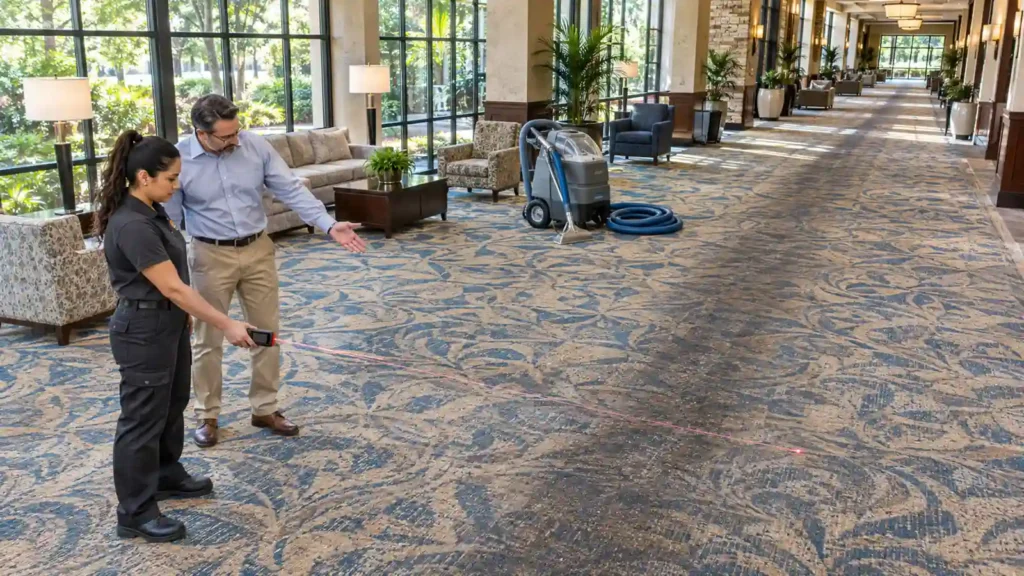
That range is a budgeting reference, not a Semper Fi price, a Yuma market average, or a guaranteed quote. Heavily soiled carpet, difficult access, stain treatment, furniture handling, limited work windows, and other requirements can produce a higher total.
Start With a Planning Range, Not a Promised Price
A useful preliminary budget multiplies the carpeted area that will actually be cleaned by a planning rate. It then adds any separately quoted treatments, access costs, or operational requirements.
| Cleanable Carpet Area | At $0.08 per Sq. Ft. | At $0.15 per Sq. Ft. | At $0.25 per Sq. Ft. |
|---|---|---|---|
| 5,000 sq. ft. | $400 | $750 | $1,250 |
| 10,000 sq. ft. | $800 | $1,500 | $2,500 |
| 20,000 sq. ft. | $1,600 | $3,000 | $5,000 |
These are arithmetic examples based on the range published in the ISSA commercial cleaning rate guide. They exclude potential minimum charges, spot treatments, furniture movement, after-hours requirements, and other scope items.
The basic planning formula is:
Cleanable carpet area × quoted unit rate + approved additions = estimated project price. This calculation becomes useful only when every provider is pricing the same area and services.
The Quoted Square Footage Matters as Much as the Rate
Gross building size is rarely the same as cleanable carpet area. A hotel may contain tile bathrooms, hard-surface lobbies, kitchens, and uncarpeted service areas. A church may have carpet only in the sanctuary, aisles, classrooms, and offices. An office may contain hard-floor breakrooms and fixed furniture footprints.
Before comparing proposals, confirm whether the measured area:
- Includes or excludes fixed furniture footprints.
- Covers stairs, landings, closets, and elevator areas.
- Includes guest rooms, corridors, offices, or only public spaces.
- Separates carpet from tile, resilient flooring, and other surfaces.
- Accounts for inaccessible or restricted rooms.
- Uses measurements from a walkthrough, floor plan, or customer estimate.
The Carpet and Rug Institute recommends that carpet-cleaning prices be based on the area actually cleaned rather than room count. Room-based pricing can still appear in a proposal, but managers should request the underlying measurements before comparing it with a square-foot bid.
What Raises or Lowers the Final Price?
Two properties with the same carpeted square footage can require very different amounts of labor. A mostly open ballroom is not equivalent to an office filled with workstations or a sanctuary with fixed seating.
Important cost drivers include:
- Soil levels in entrances, corridors, elevator approaches, and other traffic lanes.
- Spots requiring separate identification or treatment.
- Carpet fiber, construction, backing, and manufacturer instructions.
- Interim appearance cleaning versus restorative deep cleaning.
- Furniture, displays, equipment, or other obstacles.
- Stairs and areas that cannot be reached easily with standard equipment.
- Parking, loading, water, power, security, and building-access restrictions.
- Evening, overnight, weekend, or tightly limited work periods.
- Phased cleaning that requires repeated setup and breakdown.
- Ventilation, drying, traffic control, and reopening requirements.
- One-time neglected conditions versus a planned maintenance schedule.
The CRI 204 Commercial Carpet Standard explains that maintenance frequency should reflect location, use, traffic, soil exposure, existing maintenance, and manufacturer requirements. That is why one uniform rate may be misleading when the property contains several traffic conditions.
Peak Season Changes the Scope, Not Automatically the Rate
Peak visitor season does not create a universal surcharge. It can increase the project total indirectly when heavier use produces more soil or leaves fewer workable service windows.
A facility may need to pay for a more complicated scope when cleaning must be:
- Divided into smaller operational zones.
- Completed during narrow overnight or event-free periods.
- Coordinated around guests, congregants, staff, or customers.
- Repeated across several mobilizations instead of one visit.
- Scheduled with additional drying or access controls.
- Finished urgently because the work was postponed until traffic increased.
Planning before the busiest period may create larger uninterrupted work areas and reduce repeated setup. During peak season, the safer operational choice may be to prioritize entrances, main corridors, reception areas, and other visible traffic lanes rather than attempting the entire property at once.
For employee work areas, OSHA’s walking-working surface rule requires employers to keep floors dry to the extent feasible and guard hazardous conditions until corrected. A commercial proposal should therefore address traffic control and reopening, not merely the time when cleaning ends.
How Facility Type Changes the Carpet-Cleaning Scope
Each property type concentrates traffic, furniture, and scheduling constraints differently. A meaningful estimate should reflect those differences instead of assigning a price based only on the building label.
Hotels: Rooms, Corridors, and Turnover Windows
Hotel proposals should distinguish guest rooms from corridors, lobbies, elevator landings, meeting rooms, and food-service areas. Occupied-room sequencing, room availability, luggage traffic, stain treatment, and housekeeping routes can affect production.
Hotels can use the existing guide to carpet cleaning before peak visitor season to identify high-priority zones before requesting prices.
Churches: Fixed Seating and Event Calendars
Church carpet cleaning may involve long aisles, fixed pews, classrooms, offices, nurseries, fellowship halls, and entry areas with very different soil loads. Providers should know whether they can clean beneath or around fixed seating and whether furniture must be moved.
Service schedules, weddings, funerals, weekday programs, and holiday events may leave a shorter work window than the building’s weekly calendar initially suggests.
Offices: Workstations, Security, and After-Hours Access
Office carpet is often interrupted by desks, cubicles, cables, chairs, file storage, and restricted rooms. A bid should state whether technicians will clean only open traffic lanes or also reach accessible areas beneath movable furniture.
Office floor cleaning can also include hard surfaces, breakrooms, entries, or restrooms. Those services should be separated from carpet extraction so the facility manager can see what each part of the proposal costs.
Compare Commercial Carpet-Cleaning Bids on Equal Terms
A low total is not necessarily a lower price when one provider excludes services another provider includes. Normalize every proposal before selecting one.
- Confirm the measured area. Request cleanable carpet square footage by room, floor, or operational zone.
- Define the cleaning objective. Identify whether each zone needs interim appearance maintenance, deeper cleaning, spot treatment, or evaluation for damage.
- Match the method to the carpet. Review manufacturer care and warranty information before approving a process.
- List included preparation. Confirm pre-vacuuming, spot treatment, furniture handling, edge work, and any other preparation included in the price.
- Document exclusions and additions. Ask what would trigger another charge and who must approve it.
- Confirm access requirements. Include parking, loading, keys, security clearance, elevators, utilities, and after-hours entry.
- Require a drying and reopening plan. Drying varies with the cleaning method, carpet construction, extraction effectiveness, airflow, temperature, and indoor conditions. Do not rely on one universal drying time.
- Set acceptance criteria. Decide how the cleaned area will be inspected and how pre-existing damage, permanent discoloration, or recurring spots will be documented.
Carpet Cleaning Is Not the Same as General Commercial Cleaning
The question “how much does commercial cleaning cost?” covers a much broader scope than carpet cleaning alone. Routine janitorial work, carpet extraction, and hard-floor maintenance may use different schedules, equipment, production rates, and pricing models.
| Service Category | Possible Scope | Why It Needs Separate Pricing |
|---|---|---|
| Carpet cleaning | Vacuuming, interim maintenance, extraction, spot treatment | Method, soil, carpet area, and drying affect the quote |
| General commercial cleaning | Trash, dusting, restrooms, routine surface care | Usually based on tasks, frequency, and total workload |
| Office floor cleaning | Carpet plus hard-surface areas | Each flooring material may require a different process |
| Retail floor cleaning | Carpet, tile, resilient flooring, or mixed surfaces | Fixtures, operating hours, and customer access affect production |
Requesting one blended rate can make proposals difficult to compare. A clearer scope separates each flooring material and identifies which services recur throughout the year.
Build the Budget Around the Actual Property
A planning rate can help reserve funds, but a walkthrough and written scope should establish the project price. Hotels, churches, and offices should document cleanable square footage, traffic zones, carpet condition, obstacles, timing restrictions, and reopening requirements before asking providers to bid.
We offer commercial carpet cleaning for business properties. Managers preparing for peak traffic can review our commercial cleaning services and request an on-site estimate based on the property’s actual scope. Our carpet cleaning service page also explains the factors considered when preparing an estimate.
Frequently Asked Questions
Is commercial carpet cleaning priced using gross building square footage?
Usually, the more useful measurement is the clean carpet area. Gross building size may include restrooms, kitchens, hard flooring, mechanical rooms, and fixed structures that will not be carpet-cleaned. Ask each bidder to identify the measured carpet area and exclusions.
Does peak visitor season automatically increase the price?
No universal peak-season surcharge applies. Costs may rise when heavier soil, urgent scheduling, phased work, after-hours access, or repeated mobilization adds labor. A provider should identify any such charge in the written proposal instead of attributing it vaguely to the season.
Why can two carpet-cleaning quotes have very different square-foot rates?
The bids may not cover the same work. One might include pre-vacuuming, spot treatment, furniture handling, or after-hours access, while another excludes them. Compare the cleanable area, method, preparation, treatments, access requirements, and drying plan before comparing the rates.
Should hotels compare carpet-cleaning prices by room or square foot?
Square footage generally provides a clearer comparison because hotel rooms vary in size and furniture layout. If a provider quotes per room, ask what room size, preparation, furniture handling, and treatment allowance the price assumes. Public areas and corridors should be listed separately.
How do fixed pews affect church carpet-cleaning costs?
Fixed pews create edges, narrow working areas, and long sections that may slow production compared with an open room. The quote should state whether the price covers accessible aisles only or detailed cleaning around and beneath seating.
Must office furniture be removed before carpet cleaning?
That depends on the agreed scope. Some proposals cover only open traffic lanes, while others include moving selected chairs or light furniture. Fixed desks, electronics, file storage, and cables may remain in place. The proposal should assign preparation responsibilities before service day.
Is a maintenance plan always cheaper than one-time cleaning?
Not necessarily in every billing period, but scheduled care can make costs more predictable and may prevent soil from reaching a condition that requires more intensive work. Compare the total annual scope, not only the price of one visit.
Can one quote cover carpet cleaning, janitorial service, and hard-floor care?
It can, but each category should still have a defined scope and price. Separating carpet, janitorial, and hard-floor tasks makes it easier to compare providers, change frequencies, and understand which service caused a price difference.
