

Water rarely stays where it starts. In lower-desert properties, a roof leak during Arizona’s monsoon season, which runs from June through September, a failed supply line, or an appliance overflow can move fast through flooring, drywall, cabinets, and contents before the puddle even looks serious.
In homes and businesses, the real problem is not just the visible water. It is the spread into hidden layers, the contamination risk, and the decisions that follow in the first few hours.
Water spread is a structural problem, not just a cleanup problem
Small leaks become bigger losses when water migrates beyond the surface.
Professionals do not treat a water event like a simple mopping job. They look at how water moves by gravity, capillary action, and absorption. That means checking where it can travel under hard-surface flooring, behind baseboards, into insulation, into cabinetry, or through openings around fixtures and walls. That is why “looks dry” is not the same as “is dry.”
In lower-desert buildings, this matters even more after wind-driven rain, sudden plumbing failures, or floodwater intrusion. Dry weather outside does not protect the inside of a wall cavity or subfloor once moisture gets trapped. The goal is to stop migration early enough that you avoid a second wave of damage: swelling, staining, odor, corrosion, and mold.
The industry’s top guide to preventing secondary water damage makes the same point from a practical cleanup angle.
The first priority is source control and spread control
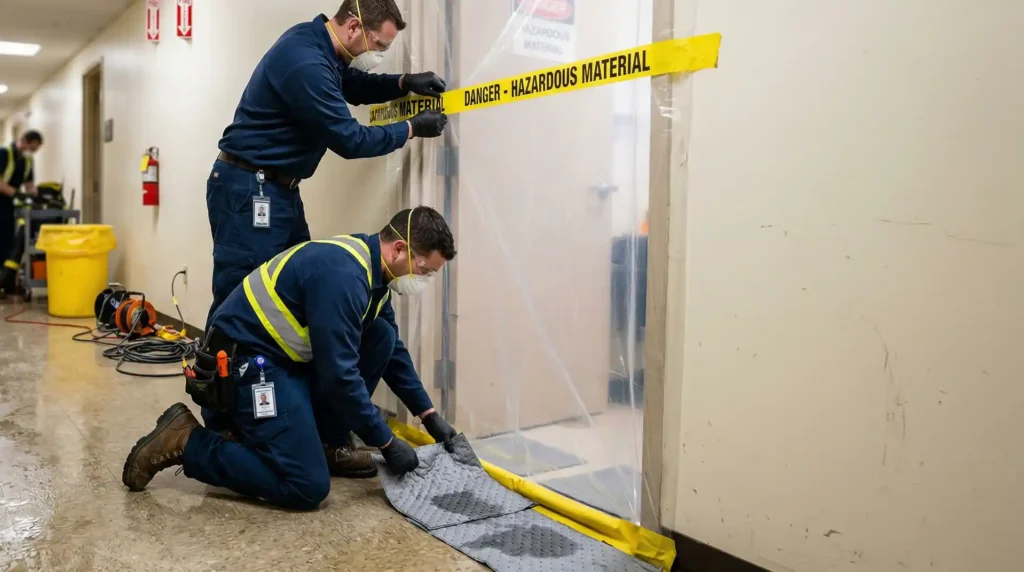
The first professional move is simple in theory: stop the water source if it is safe to do so. That may mean shutting off a valve, isolating an appliance, or addressing an opening where rain is entering. The next move is limiting the spread into adjacent rooms and materials. Professionals typically focus on removing standing water quickly, controlling foot traffic, moving contents away from wet zones, and keeping water from being pushed deeper into the structure.
This is also where safety decisions happen. If water has reached outlets, appliances, ceiling fixtures, or other electrical components, the risk is no longer just property damage. FEMA warns against using water-damaged appliances until a professional has checked them, and wet electrical conditions should be treated cautiously.
Why visible extraction matters
Removing standing water does more than make the room look better. It reduces the amount of moisture available to wick into nearby materials and shortens overall drying time. That is one reason professional water removal is usually the first operational step on serious losses. Both water damage restoration and flood cleanup involve water removal, drying, and restoration for active losses.
Why you should not trust the surface
A floor can feel dry while water remains underneath. Baseboards can look intact while drywall edges are still wet. Knowing about the hidden damage timeline after water damage helps understand how delayed problems show up after the obvious water is gone.
Drying is about the assembly, not the room
Professionals try to dry the materials that got wet, not just the air you can feel.
After extraction, professionals shift from removal to structural drying. That means managing airflow, humidity, and moisture inside materials so water does not keep migrating. Industry and government guidance consistently treat this as a timed response issue, not a wait-and-see issue.
The EPA’s 24 to 48-hour mold-prevention window is a useful benchmark because trapped moisture can start turning into a mold problem quickly.
Professionals also decide what can realistically be dried and what may need removal. Porous finishes, saturated padding, damaged drywall sections, and contaminated materials are not all equal. Clean water from a supply line is one situation. Floodwater or a backup is another. CDC and EPA both note that floodwater can contain microorganisms and chemical hazards, which change cleanup decisions.
Clean water, dirty water, and contaminated water are not the same
This is where DIY instincts often fail. A small clean-water leak may still be manageable if caught immediately. But once water has crossed dirty surfaces, entered wall systems, or caused a backup, the problem becomes more than drying.
Commercial buildings have a different spread problem
In offices, retail spaces, and managed properties, water can disrupt operations faster than it damages finishes. Hallways, shared walls, occupied suites, and tenant turnover schedules all raise the stakes. That is why commercial water events often require earlier isolation of affected zones and faster decision-making about what stays open versus what needs controlled cleanup.
The biggest professional advantage is moisture verification
One of the clearest differences between professional response and casual cleanup is verification. Professionals do not want to leave behind a wet pocket that triggers odor, staining, swelling, or mold days later. That is why the final review matters almost as much as the initial extraction.
Look into how the final walkthrough after water damage works to understand why a closeout should check dryness, finish quality, odor, and system performance before a job is considered complete.
This matters for older homes, mixed-use buildings, and properties with repeated leaks. Hidden cavities, layered flooring, and previous repairs can all make spread harder to predict. That is also why painting over a stain, running a few fans, or replacing one visible panel may not actually stop the problem.
What you should do before the water gets worse
Good decisions early can reduce both damage and cleanup scope.
- If the source is safe to access, stop it.
- Protect nearby contents.
- Avoid using household vacuums on standing water.
- Stay out of rooms with electrical risk, sagging ceilings, or contamination concerns.
- Document what got wet.
- Then make the next decision based on spread, not just appearance.
If water traveled under flooring, into walls, across multiple rooms, or came in with debris or sewage risk, that is when professional assessment becomes the safer move.
If you are weighing whether to keep handling it yourself, DIY restoration is worth reviewing before you commit to a surface-only cleanup.
If active water intrusion is spreading through your home, rental, office, or managed property, the safest next step is to get a qualified local assessment.
Call (928) 248-2302
The short answer
Professionals stop water from spreading by controlling the source, extracting visible water fast, limiting migration into nearby materials, drying the full assembly, and verifying that hidden moisture is actually gone.
That sequence is what protects lower-desert properties after monsoon intrusion, plumbing failures, appliance leaks, and sudden flood events. The puddle is only the start. The real job is stopping what the water is about to do next.
Frequently Asked Questions
1) How do professionals keep water from moving into other rooms?
They start by controlling the source, removing standing water, and reducing traffic through the wet area. They also protect nearby contents and focus on where water can wick under flooring, trim, and walls rather than only what is visible on the surface.
2) Can water still spread after the floor looks dry?
Yes. Moisture can remain under hard-surface flooring, behind baseboards, and inside wall cavities, even when the top layer feels dry. That hidden moisture can keep migrating and later show up as odor, staining, bubbling paint, or warped materials.
3) Why do professionals move so quickly after a leak or flood?
Speed matters because wet materials can become a mold risk quickly. EPA guidance uses a 24 to 48-hour drying window as a key benchmark for mold prevention, which is why delays make a manageable water event more complicated.
4) Is stopping the source enough to stop the damage?
No. Stopping the source prevents new water from entering, but it does not remove the water already inside finishes and building materials. Extraction, drying, and follow-up verification are what reduce ongoing spread and secondary damage.
5) When does a water loss become a contamination issue?
It becomes higher risk when water involves floodwater, sewage, or debris from dirty surfaces. Floodwater may contain microorganisms and chemical hazards, so cleanup decisions need to account for more than simple drying.
6) What is different about stopping water spread in commercial spaces?
Commercial properties often have a larger operational footprint, more shared walls, and more disruption if water crosses into adjacent suites or customer areas. That is why isolation, access control, and faster decisions about affected zones matter even more in managed or occupied business spaces.
7) Should you use a household vacuum to remove standing water?
No. General water-damage guidance warns against using a normal household vacuum for standing water. That can create safety issues and usually does not solve the larger moisture problem inside building materials.
8) What if water reached outlets or appliances?
Treat that as a safety issue first. FEMA advises against using water-damaged appliances until a professional has checked them, and wet electrical conditions should be handled carefully before anyone tries to restart systems or re-enter affected areas normally.
9) How do professionals know the water is no longer spreading?
They do not rely on appearance alone. The process typically includes checking likely holdout areas, reviewing odor and finish conditions, and making sure the structure has actually stabilized before the job is treated as complete.
10) Why is mold part of a water-spread discussion?
Because water that spreads into hidden areas often lingers there. Once moisture remains in wall cavities, subfloors, or low-airflow corners, mold becomes part of the decision-making about what needs drying, removal, or remediation.
11) Are monsoon leaks different from plumbing leaks?
The drying goals are similar, but the spread pattern can differ. Monsoon-related intrusion may involve roof lines, windows, doors, wind-driven entry points, and dirty water pathways, while plumbing losses often start at fixtures, supply lines, or appliances. Arizona’s monsoon season also brings heavy rain, high winds, flash flooding, and dust storms that can complicate property exposure.
12) Which local areas do you provide your services in?
We offer water damage restoration services in Yuma, Somerton, San Luis, Wellton, Tacna, Hyder, Mohawk, Aztec, and Martinez Lake.
