

Drywall problems rarely show up at a convenient time. In many desert and river-adjacent communities, the “should we save it?” debate tends to hit during seasonal shifts: wind-driven rain finds weak points, HVAC condensation surprises owners, and tenant turnovers reveal slow leaks that have been wicking behind baseboards for weeks.
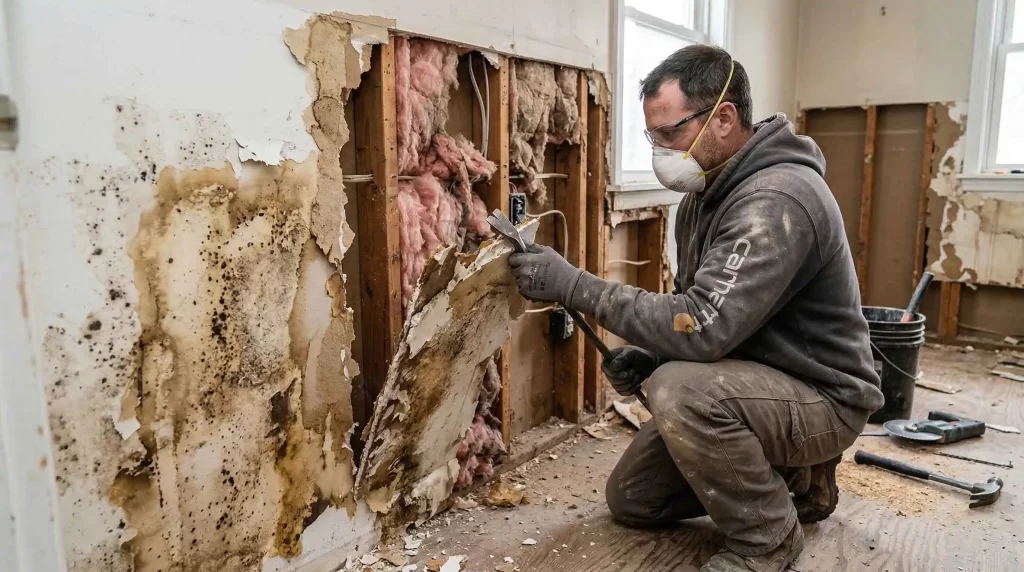
For homeowners, business owners, and property managers, the real concern is not just the visible stain. It’s the secondary damage that follows: lingering moisture, hidden mold risk, odor absorption, corrosion, warping, and finish failures.
So can water-damaged drywall be saved? Sometimes, yes. The right answer depends on the water type, time, and how far the moisture traveled.
How drywall fails when it gets wet
Drywall is a gypsum core faced with paper. Water can compromise it in a few ways:
- The paper facing absorbs moisture first. This can lead to bubbling paint, peeling texture, and weakened surface bond.
- The gypsum core can soften. Once it loses rigidity, the wall can sag, crumble at fasteners, or dent easily.
- Moisture can migrate behind it. Even if the surface looks dry, moisture can remain in insulation, studs, or the bottom edge near the floor.
Top restoration guidance on the “save vs replace” question consistently emphasizes that hidden moisture matters more than surface appearance, and professional assessment often includes checking both visible and concealed areas.
The three variables that decide: Save or replace?
1) What kind of water is it?
Think in practical categories:
- Clean water (like a supply line leak caught quickly): Drywall may be salvageable if drying is fast and thorough.
- Dirty water (like a dishwasher overflow that passed through debris): risk goes up.
- Contaminated water (sewage): replacement is commonly the safer direction because materials can absorb contaminants.
If you suspect sewage involvement, treat it as a safety issue and avoid DIY cleanup that can spread contamination. Semper Fi offers sewage backup cleanup as a service category, which is a good signal that this type of loss calls for specialized handling.
2) How long has it been wet?
The longer drywall stays wet, the higher the likelihood of swelling, softened core, microbial growth, and odor absorption. If you cannot verify when the leak started (common in older buildings, behind furniture, or in low-traffic commercial corridors), assume moisture has traveled farther than you can see.
3) How far did the moisture travel?
Water often wicks downward and sideways. Common “gotchas” include:
- Behind baseboards
- Under vinyl, laminate, or carpet edges
- Into wall cavities via electrical penetrations
- From a ceiling leak that runs along the framing before it shows up
This is why a simple “touch test” is not a reliable decision tool.
Signs that drywall might be saved
Drywall is a “maybe” candidate when conditions are limited and controllable. Look for:
- The wet area is small and localized
- Drywall is still firm (no crumbling, sagging, or deep softness)
- Paint may be stained, but the wall is not warped or separating at seams
- You can stop the source and begin drying immediately
- You are confident the water was clean (for example, a short-lived supply line drip)
In these cases, the goal becomes controlled drying: airflow, dehumidification, and verification that moisture is not trapped behind the wall.
Clear signs that drywall should be replaced
Replacement is typically the safer choice when you see:
- Sagging or “pillowing” drywall (especially ceilings)
- Crumbling edges at the base of the wall
- Swollen seams or tape lines that have lifted
- Mushy texture that dents easily
- Odor that persists after surface drying
- Any indication of contaminated water exposure
Many top restoration experts also point to “flood cut” style removal (controlled removal at the lower portion of a wall) when water wicks up from the floor, because the bottom edge is often the most saturated zone.
The safest first steps before you decide
Shut down risk, then document
- If water is near outlets or equipment, avoid stepping into it.
- Stop the water source if you can do so safely.
- Photograph staining, wet lines, flooring edges, and baseboards before moving items.
Start controlled drying (without trapping moisture)
- Increase airflow in the affected area.
- Open cabinets or closets adjacent to the wet wall.
- Avoid sealing actions (painting, caulking, patching) until you confirm dryness.
If you manage a property with repeated moisture events, remember that “re-wetting” can happen when damp framing never fully dries, and the next humidity spike pushes moisture back into finishes.
What “saving drywall” actually means
Saving drywall usually does not mean “do nothing.” It means:
- Extracting moisture from the environment
- Reducing humidity
- Confirming the wall cavity is not staying wet
- Repairing finish damage after drying is verified
This is where professional water mitigation can prevent bigger repairs later. We have a proactive approach that includes thorough drying and dehumidification, plus sanitizing to prevent mold, rather than only removing visible water.
If you are deciding whether drywall can stay, those steps are directly relevant. See our water damage restoration services overview for the types of actions involved.
What not to do (common mistakes that force replacement later)
- Do not patch over damp drywall. Trapped moisture can lead to bubbling paint, soft spots, and odors.
- Do not ignore the baseboard line. Water often concentrates low.
- Do not assume a dry surface means a dry wall cavity.
- Do not use unsafe electrical equipment around wet walls.
When it’s time to bring in a restoration team
If you are unsure about water type, timeline, or spread, a professional assessment becomes a decision-support tool. It helps answer:
- Is the drywall structurally sound?
- Is the wall cavity still wet?
- Did moisture reach insulation or framing?
- Is there a contamination concern?
We are Semper Fi Floor Care & Restoration, Veteran-owned and operated, and Licensed Contractor – ROC# 349271.” Those are the kinds of signals property owners look for when the decision affects not just cosmetics, but long-term building performance.
Frequently Asked Questions
1) Can slightly wet drywall be dried and kept?
Sometimes. If the area is small, the drywall stays firm, and the water is clean and caught quickly, drying may be possible. The key is verifying that moisture is not trapped behind the wall or at the base, where wicking occurs. When you cannot confirm the spread, an assessment helps.
2) What are the biggest warning signs that drywall must be replaced?
Sagging, crumbling, swollen seams, and persistent odor are strong indicators. If the wall dents easily or feels soft throughout, the gypsum core may be compromised. Any suspected contamination also pushes the decision toward removal.
3) Does a ceiling leak change the “save vs replace” decision?
Yes. Ceilings are more vulnerable because water can pool above the drywall, increasing the weight and collapse risk. If you see bulging or active dripping, focus on safety first and consider professional help to assess how far the moisture traveled.
4) If only the bottom of the wall got wet, can I replace just that section?
Often, yes. Many restoration approaches use controlled removal of the most saturated lower portion when water wicks up from the floor. The goal is to remove compromised material while preserving what is still structurally sound, after checking the wall cavity.
5) What if the drywall looks dry but the room smells musty?
Odor can indicate lingering moisture in wall cavities, insulation, or adjacent materials. Surface dryness is not proof that the assembly is dry. If odor persists, it’s smart to investigate hidden moisture and address it before repainting or patching.
6) How does contaminated water affect drywall decisions?
Drywall and paper facing can absorb contaminants, making cleaning difficult and increasing the risk. If sewage is involved, avoid DIY cleanup that can spread contamination. We offer sewage backup restoration as a service category, reflecting that these losses need specialized handling.
7) Should property managers handle wet drywall differently than homeowners?
The priorities are similar, but the stakes are higher: downtime, tenant disruption, and repeated exposures. Document thoroughly, prevent spread between units or suites, and avoid quick cosmetic fixes that trap moisture. Early assessment helps reduce re-wetting and repeat calls.
8) Can I repaint water-stained drywall once it “dries out”?
Not until you confirm the wall and cavity are actually dry. Painting over damp drywall can trap moisture and lead to bubbling, peeling, or odor. If the stain reappears, it often signals remaining moisture or ongoing leakage.
9) What does professional water mitigation focus on that DIY drying misses?
Professional mitigation typically goes beyond fans on the surface. Our water damage process includes thorough drying and dehumidification and a proactive approach to prevent mold, which can be critical when moisture is hidden behind finishes.
10) When should I worry about mold after a drywall leak?
Mold risk rises when moisture remains in materials and humidity stays elevated. If you cannot dry the area thoroughly or you notice a musty odor, take it seriously. It’s best to consult qualified professionals for assessment and remediation decisions.
11) Can drywall be saved if it got wet from HVAC condensation?
Possibly, if the issue is addressed quickly and the wet area is limited. Condensation problems can recur, so you also need to fix the underlying moisture source. If the wall has been re-wet multiple times, replacement and targeted drying may be more reliable.
12) What’s the fastest way to get help scheduled?
For immediate assistance, Call Now – (928) 504-6179. If you’re unsure whether drywall can be saved, that is often the quickest path to getting an assessment and a plan for drying and repairs.
