


The carpet looked clean when the holiday cleanup ended. Then a brown edge returned the next morning, an old pet spot darkened again, or a traffic lane still looked gray after vacuuming. When carpet stains keep coming back, the original spill is only one possible explanation.
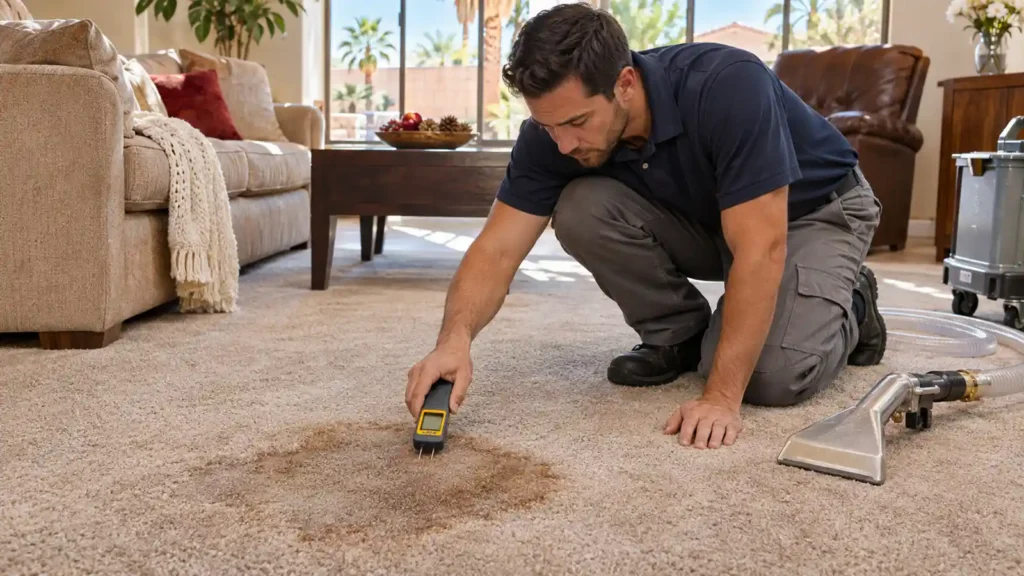
The useful question is not simply, “Which cleaner removes this stain?” It is, “Where is the source, how is it reaching the surface, and is the visible carpet still capable of returning to its original appearance?” Those three questions separate wicking, residue, and pad contamination without assuming every dark mark has the same fix.
A Recurring Stain Is a Three-Part System
A stain can return because something remains below, because moisture transports it upward, or because the cleaned surface attracts new soil. More than one part of that system may be active at once.
Source: What Remains in the Carpet Assembly
The visible face yarn is only the top layer. A large drink spill, repeated pet accident, or over-applied cleaning solution can reach the lower pile, backing, pad, and sometimes the subfloor. Material held below the surface becomes a reservoir that ordinary vacuuming cannot remove.
In this article, pad contamination means that spill material reached and remains in the carpet cushion. The term does not, by itself, identify a health hazard or a specific substance.
That reservoir does not automatically mean the pad is contaminated or must be replaced. A small amount may remain in the lower yarn or backing. The original volume, affected area, odor, moisture, and spill history help determine whether the problem extends deeper.
Old pet stains coming back through the carpet need special attention because urine may do more than leave removable soil. The Carpet and Rug Institute’s pet-urine bulletin explains that aged urine can alter carpet dye and weaken the bond between backing layers. If odor is the primary concern, see this separate guide to pee smell that returns after carpet cleaning.
Pathway: How Wicking Carries a Mark Upward
Wicking is moisture movement toward the drying surface. When cleaning re-wets soluble material near the base of the carpet, that material can travel with the moisture and collect at the fiber tips as evaporation continues.
The IICRC carpet-care guidance notes that a spill reaching the backing or pad may reappear after cleaning. Wicking is most consistent with a mark that fades while wet, then becomes visible during or soon after drying. It may re-form around the edge because the hidden deposit spreads farther than the original surface mark.
Wicking describes the transport process, not the identity of the substance. The returning material could be drink residue, tracked soil, an old spotter, pet contamination, or another water-soluble deposit. Appearance alone cannot identify it conclusively.
Surface: Why Residue Creates a Fresh Dirty Spot
Residue works at the exposed fibers. Too much cleaner, an unsuitable product, or incomplete rinsing can leave the area slightly stiff or tacky. Foot traffic and airborne dust then attach to that patch faster than to the surrounding carpet.
The IICRC warns that some consumer spot removers leave sticky, dirt-attracting residues. The Carpet and Rug Institute’s care guide also notes that detergent residue can cause rapid resoiling. In this case, the old stain may be gone while a new soil pattern develops in the same footprint.
Holiday Cleaning Can Reveal an Older Problem
Whole-room cleaning does not create every mark that appears afterward. Moisture may expose an old deposit that was already in the lower carpet, and removing surface soil may reveal dye damage or wear that dirt previously disguised.
Holiday cleanup can also add complexity when several products are layered on one spot. A stain remover, dish soap, deodorizer, rented-machine formula, and final rinse may interact with the carpet differently. More chemistry makes it harder to tell whether the remaining mark is original contamination, product residue, color change, or a combination.
Before another treatment, write down:
- What originally spilled, if known
- Roughly how much liquid was involved
- Every product and machine used
- Whether the mark returned before the carpet dried or after people walked on it
- Whether the area smells, feels tacky, stays damp, or has grown beyond its earlier boundary
This history often matters more than the color of the mark.
Not Every Dark Area Is Removable Soil
Cleaning can remove soil, but it cannot restore missing dye or rebuild worn fibers. This distinction matters when a carpet still looks uneven even though no stain is moving upward.
If the carpet looks dirty after vacuuming, view the area from opposite sides. A patch that changes from light to dark as your viewing angle changes may be pile shading, crushing, or wear. The Carpet and FabriCare Institute describes traffic-lane gray and pile distortion as appearance conditions that can remain after proper cleaning because the fibers reflect light differently.
Color that does not change with viewing direction may still be permanent alteration rather than soil. The IICRC tip sheet explains how old urine, bleach, some spotters, acne medication, and colored spills can affect carpet dyes. A lighter, orange, pink, or yellow area should not automatically receive stronger chemistry. Color correction, a repair, or replacement may be the relevant discussion.
Choose the Next Step by Depth and Condition
Limited homeowner care is reasonable only when the spot is small, the source is known, the carpet manufacturer permits the treatment, and there is no recurring odor, widespread moisture, backing damage, or reason to suspect pad involvement.
- Allow the scheduled cleaning to dry. Keep traffic away and follow the provider’s or manufacturer’s drying guidance. A dry surface does not prove the pad is dry. Unexpected dampness or a new musty odor warrants an assessment.
- Preserve the evidence. Photograph the boundary, record the products used, and note whether the carpet feels different from the surrounding area.
- Check the care instructions. Pretest any permitted product in an inconspicuous location. For a suitable small spot, the Carpet and Rug Institute recommends using a small amount on a white cloth, blotting rather than scrubbing, and removing remaining product with clear water.
- Avoid another full soaking. More water can re-wet a hidden reservoir, while more detergent can add residue.
- Stop when the scope is no longer limited. A large or unknown spill, repeated pet soiling, persistent odor, abnormal dampness, backing separation, color loss, or another unsuccessful attempt needs an assessment rather than another DIY mixture.
Never combine household cleaning products, and do not assume one treatment is suitable for wool, natural fibers, stain protectors, or every dye system.
A professional assessment should determine whether the likely source is in the face yarn, backing, pad, or subfloor and whether the visible change is removable soil at all. Targeted rinsing and extraction may address residue. Controlled treatment and drying may resolve some wicking. Pet-stain carpet cleaning may require a subsurface approach when the pad is affected.
Replacement is a consideration only when material condition, contamination extent, persistent odor, or permanent damage makes cleaning insufficient.
If a holiday-cleaning spot returns after the carpet is fully dry, our carpet cleaning service includes an initial inspection and treatment for stains and pet accidents. Share the complete stain and product history so the next step can match the affected layer rather than repeat the last attempt.
The practical lesson is to trace the system: locate the likely source, identify whether moisture or new soil is bringing the mark back, and confirm whether the carpet has a cleanable deposit or a lasting material change. That is how you stop treating every recurring patch as a request for more shampoo.
Frequently Asked Questions
Why is the returning stain larger than the original spot?
Liquid can spread laterally in the lower pile, backing, or pad before it becomes visible. Cleaning may re-wet that broader deposit, and wicking can reveal an edge beyond the earlier surface mark. A larger return does not identify the substance, but it is a reason to stop adding moisture and assess the affected depth.
Can carpet wick even if the pad is not contaminated?
Yes. Material held near the base of the yarn or in the backing can move toward the surface during drying. Pad involvement becomes more likely with a large spill, repeated saturation, recurring odor, or a mark that extends beyond the original area, but wicking alone does not prove it.
Why can an old pet stain return without an odor?
The visible change may come from remaining soil, wicking, or permanent dye damage even when odor is not noticeable. Urine chemistry and time can alter some carpet colors. Cleaning can remove removable material, but it cannot restore dye that has already changed.
What should I tell a carpet cleaner about a recurring stain?
Share the original spill if known, approximate amount, date, every product used, cleaning method, return timing, odor, texture, and whether the boundary grew. Photos taken before cleaning, while damp, and after drying can also help distinguish a surface issue from a deeper one.
Can professional cleaning guarantee that a spot will not return?
No method can guarantee removal before the source, carpet construction, depth, and material damage are known. Residue and some wicking spots may respond well to appropriate treatment. Permanent color loss, damaged fibers, deteriorated backing, or widespread pad contamination may require repair or replacement instead.
When does carpet pad need to be replaced after a pet stain?
Replacement may be appropriate when repeated or heavy saturation affects a broad area, odor remains after suitable treatment, the pad has deteriorated, or contamination cannot be adequately removed. A visible stain alone does not establish that replacement is necessary. The layers below need to be evaluated.
Why does my carpet still look dirty right after vacuuming?
Embedded soil is one possibility, but pile shading, crushing, matting, or residue can also make an area look gray. If the color changes with viewing angle or vacuum direction, the effect may come from how the fibers reflect light. If it remains tacky and darkens with traffic, residue-driven resoiling is more likely.
