


A urine stain can fade while the odor source remains inside the mattress. That distinction matters when preparing a guest room, furnished rental, or vacation property for another occupant. Fragrance, fresh sheets, and a mattress protector can conceal a problem temporarily, but they do not remove urine held below the fabric.
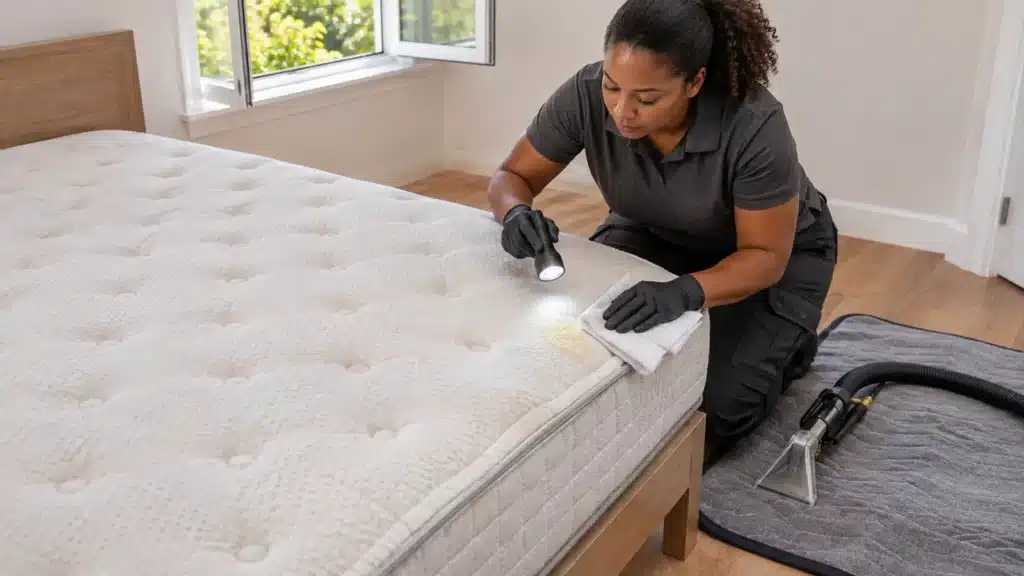
The safest approach is to use as little moisture as practical, follow the mattress manufacturer’s instructions, and keep the bed out of service until it passes a final odor, moisture, and condition check.
Inspect the Mattress Before Adding Any Cleaner
First determine whether the accident is a limited surface spot or a deeper problem. Remove all bedding and inspect the mattress top, sides, seams, underside, foundation, bed frame, nearby flooring, and any upholstered headboard.
For a rental or managed property, photograph the affected area before cleaning and record:
- Where the odor is strongest
- Whether the urine is fresh or already dry
- The approximate size of the affected area
- Whether the mattress protector failed or was missing
- Any previous cleaners applied to the mattress
- Staining, open seams, dampness, or structural damage
- Check the mattress care label, warranty, and manufacturer instructions before choosing a product.
- Instructions vary considerably.
- Do not unzip or wash a mattress cover unless the manufacturer specifically identifies it as removable and washable.
For example, Beautyrest advises against applying liquids directly to its mattresses, while Tuft & Needle permits limited spot cleaning and warns that a zippered cover is not necessarily removable.
A Low-Moisture Mattress Cleaning Process
The goal is to reach the urine residue without soaking clean material or leaving the mattress damp. Wear gloves, ventilate the room, and keep children and pets away while products are in use.
For a Fresh Accident
- Remove the bedding and mattress protector. Launder washable items according to their care labels.
- Press clean, dry, absorbent towels onto the wet area. Replace the towels and continue blotting until little additional moisture transfers.
- Do not scrub. Scrubbing can spread the affected area and push liquid farther into the cover or padding.
- Select one urine-treatment product that its label identifies as suitable for the mattress material or upholstered surfaces. A compatible enzyme cleaner may be useful because it is intended to treat organic residue rather than cover the odor.
- Patch-test the product in a concealed area and follow its dilution, application, dwell-time, ventilation, and residue-removal instructions exactly.
- Apply only the amount needed for the affected area. Do not saturate the mattress in an attempt to match the original spill depth.
- Blot or extract moisture as the product directions allow, then begin drying immediately.
For a Dried or Returning Odor
A dried stain needs source treatment, not another layer of fragrance. Locate the strongest part of the odor and apply a compatible urine treatment according to its label.
If another cleaner was previously used, do not automatically add vinegar, peroxide, bleach, disinfectant, or a second commercial product. The CDC advises against mixing cleaning products or chemicals, recommends good ventilation, and says products should be appropriate for the surface and used according to their labels.
When the treatment is completely dry, baking soda may be used as a dry surface-deodorizing step if the mattress manufacturer allows it. Vacuum it away thoroughly. Baking soda may reduce residual surface odor, but it cannot prove that urine deeper in the mattress has been removed.
Stop repeating DIY treatments when:
- The affected area is large or reaches more than one side of the mattress.
- The same location has been saturated repeatedly.
- The odor returns after the mattress dries.
- The interior remains damp.
- Prior chemical use is unknown.
- The fabric changes color or texture.
- The care instructions prohibit the moisture needed for treatment.
Drying Is Part of Cleaning
- Do not remake or reuse the bed while any part of the mattress is damp.
- Stand or position the mattress as its manufacturer permits, increase room airflow, and use fans or a dehumidifier when appropriate.
- Avoid improvised high heat that could damage foam, adhesives, fabric, or internal components.
- Drying time cannot be determined from the surface alone.
- Thick foam, pillow tops, deep saturation, indoor humidity, and limited airflow can all keep moisture below fabric that feels dry to the touch.
Use a Reuse Gate Instead of a Booking Deadline
A lighter stain does not establish that a mattress is ready for another person. Before returning the bed to service, evaluate three separate conditions.
Odor Check
- Smell the top, sides, seams, underside, foundation, and nearby floor after the cleaner’s fragrance has dissipated.
- Close the room for several hours, reopen it, and check again.
- A sharp or returning odor suggests that residue may remain below the treated surface.
Moisture Check
- Press a clean, dry towel firmly against the treated area and inspect it for moisture transfer.
- Compare the area with an unaffected part of the mattress.
- If the treated spot feels cooler, damp, or different from the surrounding material, continue drying and keep it out of service.
Condition Check
Look for spreading discoloration, fabric distortion, open seams, crumbling foam, visible growth, or damage to the foundation. A mattress that is clean enough cosmetically may still be unsuitable if its structure or interior condition has deteriorated.
| Mattress condition | Appropriate next step | Reuse status |
|---|---|---|
| One recent, limited spot; odor removed; fully dry; no damage | Complete the final inspection and add a clean protector | Reuse only after all checks pass |
| Odor returns after drying or is noticeable from multiple sides | Request professional assessment or consider replacement | Keep out of service |
| Repeated or extensive saturation | Compare professional cleaning feasibility with replacement | Keep out of service |
| Musty odor, persistent dampness, or suspected growth | Investigate the moisture source and obtain qualified guidance | Do not reuse |
| Confirmed mold growth or serious internal deterioration | Replace the mattress and correct the moisture problem | Do not reuse |
When a Mattress Smells Musty After Cleaning
Urine odor and a musty odor should not be treated as interchangeable. “Mildew” is commonly used for certain forms of mold or fungal growth, according to the EPA’s explanation of mold and mildew. However, odor or discoloration alone cannot identify a specific type of growth.
If the mattress smells musty, remains damp, or develops suspicious spotting after cleaning, stop using it and investigate the moisture source. Do not keep adding deodorizer or assume that another wet treatment will solve the problem.
Mattresses are porous, which makes internal fungal growth difficult to evaluate and remove. Health Canada’s moisture and mold guidance states that a moldy mattress cannot be properly cleaned. A mattress with confirmed mold growth should not be returned to guest or rental use.
When Professional Mattress Cleaning May Be Appropriate
Professional mattress cleaning is worth considering when an otherwise sound mattress has a large dried stain, odor that survives a careful spot treatment, unknown material requirements, or residue beyond the practical reach of a homeowner method.
Before authorizing service, ask:
- How will the mattress material and care instructions be evaluated?
- What product and cleaning method will be used?
- How will excess moisture be extracted?
- What drying conditions are required?
- How will readiness for reuse be assessed?
- What findings would make replacement more appropriate than cleaning?
No responsible assessment should guarantee that every deeply saturated mattress can be restored. Depth, material, prior treatments, age, structural condition, and drying history all affect the decision.
For properties in the Yuma area, we offer professional upholstery and mattress cleaning, including an initial review of material condition, stains, and odor concerns. Property managers preparing an entire unit can also use our apartment turnover cleaning guide to separate routine cleaning from moisture, contamination, and restoration concerns.
Prevent the Next Accident From Reaching the Mattress
Once the mattress is clean, dry, and suitable for reuse, install a washable waterproof protector that fits securely. Rental and guest-room operators should keep a spare protector available so a removed cover is replaced before the bed is remade.
A practical reset should include:
- A clean, fully dry mattress
- A laundered or replaced mattress protector
- Fresh bedding
- Documentation of the treatment and final inspection
- A follow-up odor check before the next arrival
- Replacement planning if accidents are frequent or the mattress is already deteriorating
The final question is not whether the bed can be made to smell pleasant for a few hours. It is whether the odor source has been addressed, the mattress is fully dry, and its condition supports responsible reuse.
Frequently Asked Questions
Can a mattress be used the same night it is cleaned?
Only if the mattress is completely dry, free of objectionable odor, and otherwise in suitable condition. A surface that feels dry does not prove that deeper foam or padding has dried. If there is uncertainty, keep the bed out of service and allow more drying time.
Can enzyme cleaner be used on a memory foam mattress?
Only when both the mattress instructions and cleaner label permit the application. Memory foam can retain liquid, and some manufacturers restrict direct liquid use. Patch-test the product, use the smallest effective amount, and avoid saturating the foam.
Will baking soda remove urine smell from a mattress?
Baking soda can help with limited residual surface odor and moisture, but it does not establish that urine deeper in the mattress has been removed. If the smell returns after vacuuming and drying, the source may be beyond the treated surface.
Are vinegar and hydrogen peroxide safe for every mattress?
No. Mattress fabrics, foam, latex, dyes, adhesives, and fire-barrier materials can react differently. Hydrogen peroxide may cause discoloration, and some manufacturers prohibit liquid cleaners. Follow the mattress and product instructions instead of assuming a popular homemade formula is compatible.
Can bleach be used on a urine-stained mattress?
Bleach is generally a poor choice for routine mattress spot cleaning because it may damage mattress materials and introduce hazardous fumes or residues. Never mix bleach with ammonia, vinegar, or another cleaner. Use one surface-compatible product according to its label.
Does a musty mattress smell prove that mold is present?
No. A musty smell can indicate a moisture problem, but smell and appearance alone cannot conclusively identify fungal growth. Persistent mustiness, dampness, visible growth, or a history of prolonged wetness warrants further assessment, and the mattress should remain out of use.
When should a urine-damaged mattress be replaced?
Replacement becomes the more defensible option when there is confirmed mold growth, repeated deep saturation, structural deterioration, persistent internal dampness, or odor that remains after appropriate cleaning and drying. A professional inspection may help when the extent of penetration is unclear.
What should a rental operator document after a mattress accident?
- Record the mattress’s prior condition if available, the affected area, photographs, products and methods used, drying period, final odor and moisture checks, and the decision to clean or replace.
- Keep the record factual and separate from any legal or reimbursement determination.
