


You reopen the house after summer, step into the living room, and notice it immediately: the couch smells like a dog. The odor may seem new or unusually strong, even though the furniture looked clean when you left.
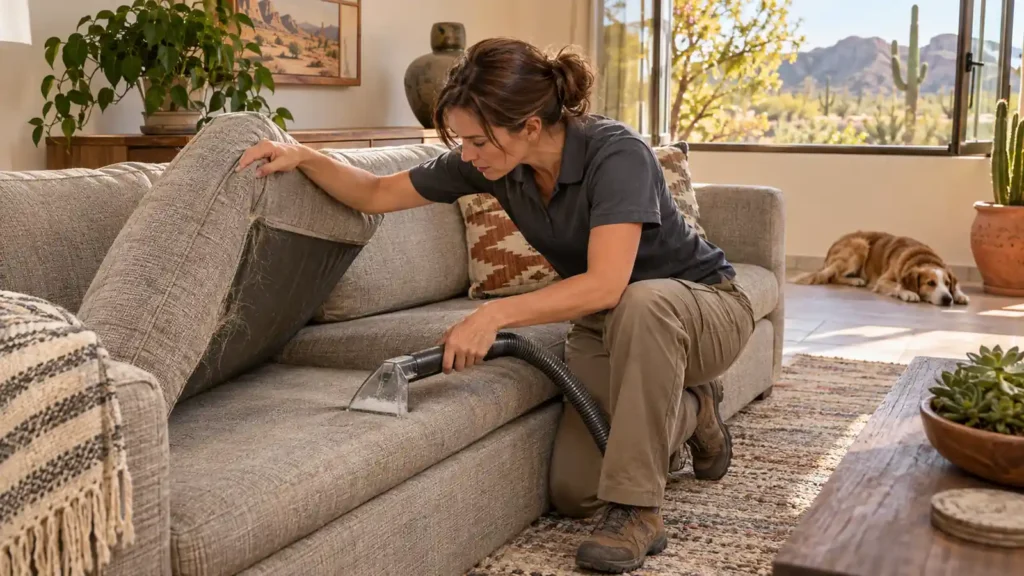
A closed room can make existing odors more noticeable, but that does not identify their source. Pet hair, body oils, urine, cleaning residue, damp cushion filling, and even the floor beneath the couch can create different problems. Before adding fragrance or soaking the upholstery, determine which layer is holding the odor.
Start With an Odor Map, Not Another Spray
The strongest-smelling location often tells you more than the strength of the odor. A short inspection can help distinguish a cleanable surface problem from contamination inside the furniture.
- Ventilate the room and remove washable throws, pet beds, and blankets.
- Vacuum loose hair and debris from the cushions, seams, deck, back, and floor beneath the couch.
- Check each cushion separately, including its underside and the surface below it.
- Note whether the smell is spread evenly or concentrated in one seat, seam, or corner.
- Look for old rings, yellowing, sticky fabric, water marks, or areas previously treated with household products.
- Recheck after the room and furniture have aired out. Do not judge the result while a deodorizer or cleaner is masking the odor.
- Do not press your face into upholstery that appears damp, visibly contaminated, or affected by fungal growth. Odor and discoloration alone cannot identify mold.
- If the smell is musty rather than distinctly pet-related, check for leaks and damp materials before treating the couch as a routine cleaning job.
What Upholstery Cleaning Can and Cannot Remove
Professional cleaning is not one universal “steam” process. The current ANSI/IICRC S300 upholstery-cleaning standard covers fabric construction, inspection, cleaning methods, spot treatment, and post-cleaning evaluation because the safe approach depends on the individual piece.
| Condition | What cleaning may accomplish | Important limitation |
|---|---|---|
| Hair, dust, and dry debris | Remove loose material from accessible fabric and seams | Debris may remain inside inaccessible construction |
| Body oils and ordinary pet residue | Improve compatible fabric through appropriate cleaning and rinsing | Repeated pet contact can reintroduce odor |
| Surface spots | Remove or reduce many treatable residues | Dye loss, fading, wear, or chemical damage is not removable soil |
| Light odor in face fabric | Remove or reduce an accessible odor source | Fragrance alone does not prove the source is gone |
| Urine below the cover | Improve the cover and reachable material | Foam, fiberfill, decking, or frame contamination may remain |
| Damp or musty upholstery | Clean suitable fabric after the moisture source is resolved | Cleaning cannot repair an active leak or guarantee recovery of damaged filling |
A responsible evaluation separates removable contamination from permanent material change. More aggressive treatment is not necessarily better when the fabric, dye, backing, or filling could be damaged.
Separate Dog Odor, Urine, and Moisture Problems
These odors can overlap, but they should not automatically receive the same treatment. The location, history, and behavior of the smell provide useful clues.
Everyday Pet Odor Is Usually Broadly Distributed
General dog odor is often strongest where the animal regularly sleeps or leans against the couch. Hair, skin flakes, outdoor soil, and body oils may affect several cushions, the arms, and nearby blankets rather than one sharply defined spot.
Vacuuming and cleaning compatible upholstery may substantially improve this type of buildup. The odor can return, however, if pet bedding, washable covers, or nearby rugs remain untreated.
Urine Odor Usually Points to a Specific Layer
A urine smell in couch cushions is more concerning when it is concentrated in one area or strongest beneath a removable cover. According to the IICRC’s consumer upholstery guidance, urine can pass beneath the fabric into fiberfill, down, cushion interiors, and structural materials.
Cleaning the visible cover may therefore produce a cleaner-looking cushion without reaching every deposit. For heavy contamination, cleaning and deodorizing the cover may need to be paired with replacement of the affected cushion core.
A Musty or Sour Odor Calls for Moisture Investigation
A musty smell after a house has been closed may come from the couch, but it may also involve a wall, floor, rug, leak, condensation, or retained moisture beneath the furniture. The EPA advises correcting moisture problems and notes that mold can be difficult or impossible to remove completely from some porous materials.
Our guide to rug and upholstery cleaning after late-summer leaks explains why the exposed fabric can feel dry while padding or surrounding materials still need attention.
Why Couch Stains Can Return After Cleaning
If stains keep returning on the couch after the fabric dries, the original residue may not have been confined to the visible surface.
Moisture can dissolve or suspend material below the face fabric. As the upholstery dries, some of that material may migrate toward the surface and create another mark. This movement is commonly called wicking. A returning spot can also result from cleaner residue that attracts new soil.
Not every reappearing mark is wicking. Other possibilities include:
- dye migration from the fabric or material beneath it;
- browning or water rings caused by overwetting;
- permanent discoloration that looked less visible while wet;
- texture or pile changes that reflect light differently; or
- a new pet accident in the same area.
Record when the mark returns. A spot that reappears during drying suggests a different problem from an area that gradually darkens over several weeks.
Use a Care-Code Check Before Any DIY Treatment
A zipper does not mean a cushion cover is machine washable. Removing or washing a cover contrary to its instructions can cause shrinkage, damaged backing, seam distortion, or a poor fit.
Look beneath the cushions or frame for the manufacturer’s instructions. Common upholstery codes include:
- W: Use only an approved water-based upholstery cleaner.
- S: Use only an appropriate water-free solvent.
- WS or SW: Either category may be permitted.
- X: Vacuuming or light brushing only; do not apply liquid cleaner.
Manufacturer directions can be more specific than the letter code. Both Ashley’s upholstery-care guidance and La-Z-Boy’s fabric-care instructions caution against saturation and explain that some cushion covers should not be removed for washing.
For a small, fresh urine accident on colorfast upholstery, blot promptly and follow both the furniture manufacturer’s directions and the urine-treatment product label. The American Cleaning Institute recommends testing a hidden area and allowing treated upholstery to dry completely.
Stop DIY treatment when:
- the care code is missing or prohibits the proposed cleaner;
- urine has entered a fixed cushion or internal frame;
- the fabric is delicate, unstable, faded, or already damaged;
- previous products have left rings, stiffness, or discoloration;
- the affected area is large or repeatedly contaminated; or
- the couch is damp, musty, or associated with a leak.
When Is Professional Couch Cleaning Worth It?
The value of professional cleaning depends less on odor strength than on whether the source can be reached without damaging the furniture.
| Situation | Practical decision |
|---|---|
| Broad dog odor, loose hair, and normal soil | Professional cleaning is often a reasonable salvage step |
| One recent, localized accident | Evaluate the cover, insert, and depth before choosing treatment |
| Repeated urine incidents in removable cushions | Compare cleaning plus insert replacement with furniture value |
| Urine in attached cushions or frame materials | Expect greater uncertainty and discuss realistic limitations |
| Musty odor after a leak or unexplained dampness | Investigate moisture before routine upholstery cleaning |
| Bleaching, fading, worn fibers, or fabric damage | Cleaning may remove soil but will not reverse the damage |
Before booking, ask:
- What fabric and cleaning code do you believe this couch has?
- Which layers appear affected?
- Does the proposed scope address only the cover or also the cushion interior?
- How will the upholstery be dried and evaluated afterward?
- What result is realistic if odor remains in the foam or frame?
If the problem appears cleanable, our upholstery and mattress cleaning service can assess the fabric, condition, stains, and odor concerns before treatment.
The final result should be evaluated only after the couch is fully dry and treatment fragrances have dissipated. If the same cushion still smells, the remaining issue is likely a source-depth problem rather than proof that the exterior needs to be soaked again. Sometimes professional cleaning is worthwhile; sometimes replacing a contaminated insert is the more honest answer.
Frequently Asked Questions
Did the closed-up summer house create the dog smell?
Not necessarily. Reduced air exchange can make an existing odor more noticeable when you return. Summer conditions may also reveal a previously overlooked urine or moisture problem, but odor alone cannot determine which source is present.
Can professional cleaning remove urine smell from couch cushions?
It may remove or reduce urine odor when the affected material is accessible and compatible with treatment. Results are less predictable when urine has entered thick foam, fiberfill, attached cushions, decking, or the frame. A deeply contaminated insert may require replacement.
Why does my couch smell worse after I clean it?
Cleaning can temporarily wet residues that were already below the surface. The couch may also have been overwet or may be drying too slowly. Let it dry completely and identify whether the odor is pet-related, chemical, sour, or musty before adding another product.
Why do stains keep returning on the couch?
A stain may wick from deeper material toward the surface as the cushion dries. Cleaner residue can also attract new soil, while dye migration, water rings, and permanent discoloration can resemble returning stains. The timing and appearance of the mark help narrow the cause.
Should I wash removable cushion covers?
Only when the manufacturer explicitly permits it. A removable cover can still shrink, lose its backing, distort at the seams, or no longer fit the insert after washing. Follow the furniture label rather than assuming the zipper is a laundering instruction.
How long should I wait before judging an odor treatment?
Wait until the cover and cushion interior are completely dry and any treatment fragrance has faded. There is no universal drying time because fabric, cushion construction, airflow, temperature, humidity, and the amount of liquid used all affect the result.
When does replacing the cushion make more sense than cleaning it?
Replacement becomes more reasonable when a core has been repeatedly saturated, urine odor remains after an appropriate treatment and full drying, or reaching the contamination would require damaging the upholstery. Compare the cost of a new insert or reupholstery with the couch’s value and condition.
Should I use an ozone generator to remove dog odor?
Do not use an ozone generator in an occupied space. The EPA states that ozone can irritate the lungs, may create harmful byproducts, and has limited ability to remove many indoor contaminants at concentrations that meet public-health standards. Removing or treating the actual odor source remains the priority.
