

Does mold remediation include replacing drywall? Sometimes, but removal and replacement are not automatically the same service.
Mold remediation may require removing contaminated drywall so the wall cavity, framing, and insulation can be inspected and cleaned. Installing new drywall is reconstruction. One contractor may handle both phases, or replacement may appear as a separate item in the written project scope.
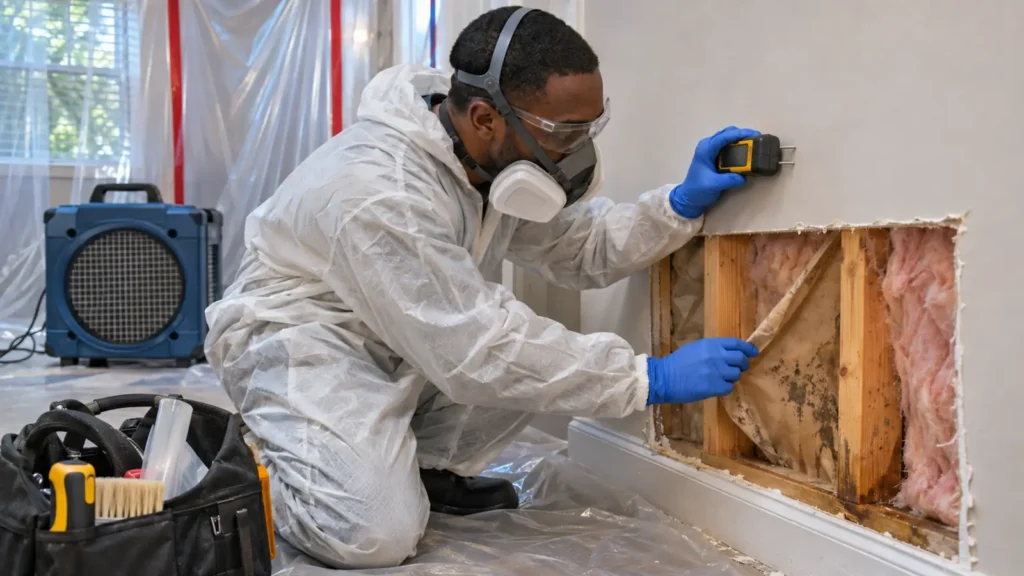
The decision to remove or dry drywall depends on more than whether the visible side looks clean. A hidden leak can wet the paper backing, insulation, fasteners, and framing while the painted surface appears relatively normal. As our guide to brief water events and hidden mold risk explains, surface drying does not confirm that concealed materials are dry.
Mold is a type of fungal growth. “Mildew” is often used informally for light surface growth, but the term does not establish a different cleanup category. Color, odor, or staining alone also cannot identify a mold species or determine how far growth extends.
Mold Remediation and Drywall Replacement Are Separate Phases
Understanding the two phases helps you compare estimates and avoid discovering an unfinished wall after remediation is complete.
Remediation Addresses Contamination and Moisture
Depending on the findings, remediation can involve:
- Locating and correcting the moisture source
- Establishing appropriate containment
- Removing drywall or insulation that cannot be adequately cleaned and dried
- Cleaning salvageable framing and other materials
- Drying the wall cavity
- Evaluating whether the remediation objectives have been met
The current ANSI/IICRC S520 Standard for Professional Mold Remediation addresses structural remediation and post-remediation verification as distinct project components.
Reconstruction Restores the Finished Wall
Reconstruction begins after affected materials have been removed, the moisture source has been corrected, and the retained assembly is ready to be enclosed. It may include:
- Replacing insulation
- Installing the correct type and thickness of drywall
- Restoring fire-rated or sound-rated assemblies
- Taping and finishing joints
- Priming, painting, and reinstalling trim
Ask whether the estimate includes both remediation and reconstruction. A line stating “remove affected drywall” does not necessarily include new drywall, finishing, or paint.
Four Gates Determine Removal Versus Drying
No single stain, meter reading, or timeline answers the question by itself. A defensible decision considers the water source, wetting duration, material condition, and concealed side of the wall.
1. What Water Reached the Drywall?
Drying may be considered when the leak has been stopped and the water was uncontaminated. Even then, a supply-line leak should not be treated as automatically clean after water has remained inside a wall, contacted other materials, or passed through dirty spaces.
Drywall exposed to sewage or floodwater generally requires removal. The Gypsum Association’s water-damage guidance states that gypsum boards exposed to sewage or floodwater must be replaced. The CDC similarly advises removing drywall and insulation contaminated by those water sources.
2. How Long Was the Assembly Wet?
Prompt drying improves the possibility of saving undamaged drywall, but 24 to 48 hours is a response target, not a promise that every panel remains mold-free during that period.
The EPA’s residential mold guidance recommends drying wet materials within 24 to 48 hours when possible. Unknown leak duration, repeated wetting, or moisture that remained trapped beyond that period weighs toward opening the wall and removing affected porous materials.
3. Is the Drywall Still Physically Sound?
The EPA states that drywall affected by clean water may be dried in place when there is no obvious swelling and the seams remain intact. Otherwise, removal is necessary. The wall cavity must also be ventilated if the board remains in place.
Removal becomes more likely when drywall has:
- Swollen, sagged, buckled, or become soft
- Lost adhesion between its paper and gypsum core
- Crumbled around fasteners
- Opened at seams
- Developed rusting fasteners
- Lost the properties required for a fire-rated or sound-rated assembly
A panel can feel dry at the surface and still be too damaged to retain.
4. What Is Behind the Painted Face?
The back of drywall often gives the hidden leak its least visible surface and its most favorable place for growth. The EPA identifies the back side of drywall and damp wall cavities as common hidden-mold locations.
Planned access may be necessary when there is:
- A persistent musty odor
- Recurring staining or bubbling paint
- Wet insulation
- Moisture readings that remain elevated compared with known-dry areas
- Visible growth at an opening or baseboard
- A leak path that entered from behind the panel
- Uncertainty about how long the leak continued
A handheld moisture meter can help compare wetter and drier areas, but it does not prove that drywall is clean or provide a universal pass-or-fail number. Meter type, calibration, salts, fasteners, coatings, and the material being tested can affect the reading.
A Practical Dry-or-Remove Decision Grid
The conditions should be evaluated together. One favorable fact does not cancel contamination, material damage, or concealed growth.
| Finding | Likely Direction | Why |
|---|---|---|
| Promptly addressed, uncontaminated leak; sound panel; intact seams; accessible cavity | Consider controlled drying | EPA guidance allows sound drywall to dry in place under limited conditions |
| Unknown or prolonged wetting | Further assessment or removal | Porous materials may have supported concealed growth |
| Visible growth on the paper face or back | Controlled removal is often appropriate | Growth can extend into porous facing and concealed surfaces |
| Sewage or floodwater exposure | Remove affected drywall | Contaminated porous material is not handled as a clean-water drying project |
| Swelling, sagging, softness, delamination, or damaged seams | Remove damaged board | The panel may no longer perform as intended |
| Wet insulation or an inaccessible cavity | Open the assembly as needed | The wall cannot be considered dry based only on its visible face |
| Dry surface but recurring odor or staining | Investigate before closing or painting | The leak, cavity moisture, or affected material may remain unresolved |
What Must Happen Before the Wall Is Closed
Rebuilding too early can conceal the same conditions that caused the project. Before new drywall or finishes go in, confirm four points:
- The leak source has been corrected. A repair should address the actual pipe, roof, drain, condensation, or exterior-water path, not only the interior stain.
- Affected material has been removed or successfully cleaned. There should be no remaining visible growth or moldy odor in the work area.
- The retained assembly is dry. Framing, sheathing, and other retained materials should be compared with appropriate dry reference areas using properly interpreted measurements.
- The remediation scope has been evaluated. The EPA’s remediation-completion guidance calls for the moisture problem to be fixed, mold removal to be complete, and the area to show no continuing water damage or mold growth.
Routine air testing is not automatically required for every project. CDC and NIOSH explain that short-term air samples can be difficult to interpret and recommend visual assessment and moisture investigation as core tools. Testing may still be appropriate when a project specification, consultant, legal issue, occupant concern, or unusual condition calls for it.
Our mold remediation services and water damage restoration services address mold and moisture-related damage. Ask us to separate assessment, removal, drying, verification, and reconstruction in the written scope so you know exactly what is included.
Know When to Stop a DIY Inspection
Do not cut into a wall simply to check whether the back of the drywall is moldy. Disturbing concealed growth can release dust and particles into occupied areas.
Stop and seek qualified assessment when:
- The affected area may be extensive or continues into adjoining rooms
- Sewage, floodwater, or another contamination source is involved
- Electrical components or a sagging ceiling may have been affected
- Mold may have reached an HVAC system
- Someone in the household has immune suppression, significant allergies, asthma, or underlying lung disease
- Demolition could disturb lead-based paint or asbestos-containing material
For pre-1978 housing, paid renovation work that disturbs painted drywall may fall under the EPA’s Lead Renovation, Repair and Painting requirements. Drywall, joint compound, or related materials cannot be ruled free of asbestos by appearance alone; the EPA recommends qualified assessment when suspect material will be disturbed.
The central rule is straightforward: drywall stays only when the source is controlled, the water history is acceptable, the panel remains sound, and the entire affected assembly can be dried and evaluated. When any of those conditions fails, removal is often the more defensible path. Replacement should then occur only after the hidden space is ready to be closed.
Frequently Asked Questions
Does mold remediation always require replacing drywall?
No. Sound drywall affected by a promptly addressed, uncontaminated leak may sometimes be dried in place. Replacement becomes more likely when mold is growing on or behind the paper facing, the panel is damaged, the water was contaminated, wetting was prolonged, or the cavity cannot be adequately inspected and dried.
Can drywall be saved if no mold is visible?
Possibly, but the visible face is not enough to make that decision. The leak duration, water source, panel condition, insulation, cavity access, and drying progress all matter. Hidden growth can occur on the back of drywall before it appears in the room.
How far beyond visible mold should drywall be removed?
There is no universal number of inches that applies to every wall. The removal boundary should account for the moisture path, visible or concealed damage, insulation, adjacent materials, and the containment plan. A fixed cut line should not replace project-specific assessment.
Is a moisture-meter reading enough to prove drywall can stay?
No. A meter can help locate wetter areas and track drying, but readings require the correct instrument, calibration, comparison points, and interpretation. A low surface reading does not confirm that insulation, the back of the panel, or the rest of the cavity is dry and unaffected.
What should I do after mold remediation?
Confirm that the leak was repaired, obtain documentation of what was removed and retained, review any completion or verification findings, and make sure the cavity is dry before reconstruction. Also clarify who will replace insulation, drywall, trim, and paint.
Does mold come back after remediation?
It can. Mold may return when the original leak persists, condensation continues, wet material remains concealed, or a new moisture problem develops. Effective remediation removes affected growth and addresses the moisture conditions that allowed it to develop.
When do you need mold remediation instead of water-damage drying?
Mold remediation becomes more relevant when fungal growth is visible or reasonably suspected, a musty odor persists, the wetting duration is unknown or prolonged, growth may be hidden inside the wall, or mold returns after surface cleaning. Prompt clean-water drying before growth develops is a different project path.
Is mold testing required before new drywall is installed?
Not in every case. CDC does not recommend routine mold testing, and EPA guidance emphasizes moisture correction, visual inspection, removal of mold-damaged material, and the absence of moldy odor. Testing or independent post-remediation verification may be appropriate when required by the project plan or when unusual, disputed, or high-risk conditions exist.
