

A splash of red wine, gravy, punch, or eggnog may look like one problem: a visible mark on the rug. The cleaning decision is more complicated. The spill itself matters, but so do the rug’s dyes, face fiber, fringe, foundation, backing, and any treatment already applied.
That is why a reliable rug stain removal plan begins with identification, not a stronger product. A method that is reasonable for a colorfast synthetic rug may spread dye, distort viscose, weaken fringe, or carry residue deeper into a hand-tufted rug.
The safest first response is deliberately limited: remove what you can without scrubbing or saturating, then stop when the rug’s construction or the spill’s depth is uncertain.
Start With the Rug, Not the Stain Recipe
Two rugs with the same holiday spill may need different treatment. Before adding moisture or cleaner, check the care label, fiber description, construction, age, prior damage, and whether earlier blotting caused any rug color to transfer.
Dye stability controls how much chemistry and moisture are safe
Colorfastness means a dye resists transferring or changing under expected cleaning conditions. It is not something you can assume from price, age, or country of origin. The IICRC’s consumer guidance for area rugs notes that excess moisture, urine contamination, high pH, and aggressive cleaning agents can contribute to dye migration, often called bleeding.
If rug color transfers during a label-approved test in an inconspicuous area, treat that as a stop signal, not an invitation to keep rinsing. Continuing may move color into a pale field or fringe and turn one stain into a larger color problem.
Fiber type changes what “gentle” means
Wool, silk, cotton, viscose, jute, and synthetic fibers do not react alike. Plant-based and regenerated fibers can be especially moisture-sensitive. WoolSafe’s fine-fiber guidance warns that water-based spot removers can cause watermarks, pile distortion, or spreading on materials such as sisal, seagrass, coir, viscose, Tencel, and bamboo.
If the label is missing or the fiber is uncertain, limit your response to careful absorption and seek material-specific advice. “Natural fiber” is not a cleaning method.
Fringe may be trim or part of the rug’s structure
On many hand-knotted rugs, fringe is the visible end of the foundation yarns. On other rugs, it may be machine woven or sewn on. The distinction matters because weakened structural fringe can unravel or break, while aggressive brushing, vacuuming, or whitening can cause additional damage.
Fringe that is brittle, loose, stained by migrating dye, or separating from the rug should not be scrubbed as a separate white border. Its condition belongs in the cleaning assessment.
Backing determines where the spill can hide
Some rugs are woven so the pattern can be seen on the reverse. Others are tufted and rely on adhesive and secondary backing to hold the face yarns in place. A spill that passes through the pile may reach adhesive, foundation yarns, a rug pad, and the floor below.
Surface improvement does not prove those layers are clean or dry. If the underside is wet, powdery, cracked, separating, or strongly odorous, adding more liquid from the top can complicate the condition. When liquid has traveled beyond the face fibers, the rug may need a broader cleaning and drying assessment.
What to Do in the First Few Minutes
The immediate goal is to remove excess material without spreading it or making the rug wetter. These are limited first-response steps, not a universal stain-removal formula.
- Lift solid or semi-solid material with a spoon or another dull edge. Work carefully so you do not press it deeper into the pile.
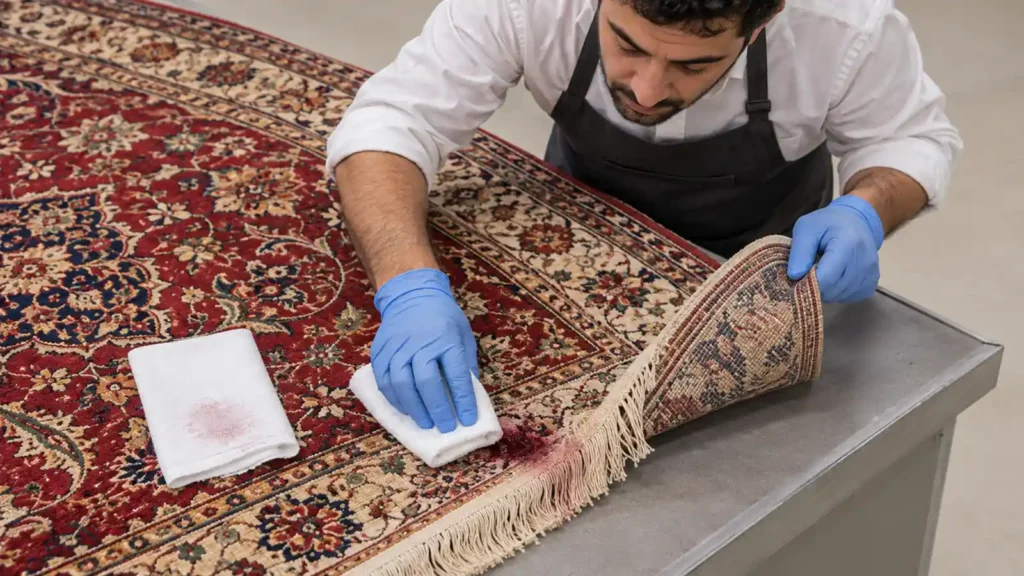
- Blot liquid with a clean, dry, white absorbent cloth. Work from the outer edge toward the center and change to a clean section as material transfers.
- Check the rug’s care label before applying any product. A carpet spotter, laundry product, bleach, or homemade mixture may be incompatible with the rug.
- Stop if rug color transfers, the pile texture changes, the area spreads, the fringe is involved, or liquid has reached the back. Repeated experimentation reduces the professional cleaner’s options.
- Keep people and pets off the damp area and monitor it as it dries. Do not use direct high heat or put the rug back over a wet pad or floor.
The Association of Rug Care Specialists’ spotting guide likewise recommends prompt blotting with a white towel, avoiding rubbing and over-wetting, and pretesting any suitable spotting solution in an inconspicuous area. Manufacturer instructions still control when they are more specific to your rug.
Match the Cleaning Plan to the Failure Risk
The visible stain is only one part of the decision. Use the rug’s response and construction to determine whether limited homeowner care should stop.
| What you observe | What it may change | Safer next step |
|---|---|---|
| No color transfer; small, fresh surface spill; care label allows spot cleaning | Limited absorption or label-directed spot care may be reasonable | Follow the label exactly and avoid saturating the area |
| Dye transfers or a pale area takes on another color | The rug may not be colorfast under the attempted condition | Stop adding moisture or cleaner and arrange an assessment |
| Fringe is weak, discolored, or carrying dye | Cleaning may affect the rug’s foundation or worsen visible contrast | Do not scrub or bleach the fringe |
| Moisture or odor is present on the reverse | Residue may have moved beyond the face yarns | Check the pad and floor; consider professional rug cleaning |
| Backing is powdery, brittle, cracked, or separating | The rug may already have adhesive or construction deterioration | Avoid repeated wetting and ask whether cleaning, repair, or replacement is practical |
| Fiber or construction is unknown, delicate, handmade, or valuable | Trial-and-error cleaning carries a higher consequence | Photograph the label and spill, then get rug-specific guidance |
This framework avoids a common mistake: choosing a product before deciding what can fail.
Odor Means the Spill May Be Deeper Than the Stain
Effective rug odor removal depends on reaching the source without harming the rug. A fragranced product may change what you smell temporarily while leaving residue in the pile, foundation, backing, or pad.
Pet accidents make this tradeoff clearer. With pet urine rug cleaning, surface spotting may leave the lower layers untouched. Urine can affect dyes, and repeated or heavy deposits may reach the rug’s lower layers. The cleaner needs to consider color stability, construction, the affected depth, prior treatments, and whether the pad or floor also needs attention.
Complete odor removal cannot be promised before those conditions are assessed. The same depth question applies to milk-based drinks, gravy, and other holiday spills that leave organic or oily residue. If an odor returns after the surface looks better, stop layering products. The remaining source may be below the area you treated.
The Best Plan Preserves Options
Good first aid removes excess spill and avoids creating a second problem. It does not try to finish every job with whatever cleaner is nearby.
If the stain is small, the rug is colorfast, the label permits spot cleaning, and nothing has reached the underside, careful label-directed treatment may be enough. If dye moves, fringe is vulnerable, the backing is affected, odor persists, or the rug’s identity is uncertain, professional rug cleaning can begin with an inspection instead of guesswork.
We offer area rug cleaning in Yuma and evaluate a rug’s material, construction, condition, and specific concerns before selecting a cleaning plan. Share what spilled, what products have already been used, and whether the underside or pad became wet. Those details can change the recommendation as much as the stain’s appearance.
Frequently Asked Questions
Can I use a carpet stain remover on an area rug?
Only if the rug manufacturer’s care instructions allow that product or product type. “Carpet-safe” does not mean suitable for every wool, silk, viscose, jute, hand-knotted, or latex-backed rug. If the label is missing, avoid trial-and-error applications.
Why did the stain get larger after I cleaned it?
Added liquid may have spread the original spill, moved dye, carried residue outward, or allowed material from lower layers to wick back toward the surface during drying. Stop adding products until the rug’s fiber, color stability, and construction are understood.
Is dye transfer onto a white towel always permanent damage?
Not necessarily, but it shows that color is moving under the test condition. Stop the test and avoid further moisture or chemistry. Whether the appearance can be corrected depends on the dye, affected colors, extent of migration, and rug construction.
Can I clean the rug fringe separately with bleach?
Do not assume bleach is safe. Fringe may be part of a hand-knotted rug’s structural foundation, and bleaching can weaken fibers or create a harsh color contrast. Loose, brittle, or dye-stained fringe needs rug-specific evaluation.
Why does a rug still smell after the visible stain is gone?
The odor source may remain in the foundation, backing, pad, or floor, or cleaning residue may be contributing. Surface appearance and odor-source removal are different outcomes. A returning odor is a reason to investigate depth rather than add fragrance.
When does a holiday spill need professional rug cleaning?
Professional evaluation is prudent when color transfers, the spill is large or old, the rug is delicate or valuable, fringe is involved, the backing becomes wet, odor persists, or previous products have changed the color or texture. These conditions make further experimentation more consequential.
Should I move a wet rug off a wood floor?
Do not leave a wet rug or pad against a moisture-sensitive floor. If the rug is small enough to move safely without folding, dragging, or spreading the spill, separate it from the floor and follow its care instructions. For a large, heavy, delicate, or color-bleeding rug, get help rather than risking injury or additional damage.
